


 English
Nineteen hardy adults and an equally hardy two-year old met in the car park at Lissan House on Saturday 4th May at 6.00am. We were led by Shane McGarvey. It was a damp drizzly morning but with no wind which is the main adverse weather condition if listening for bird song or birdwatching.
We were joined by Veronica and Matt from the BBC who are making a programme focusing on nature through the seasons at Lissan.
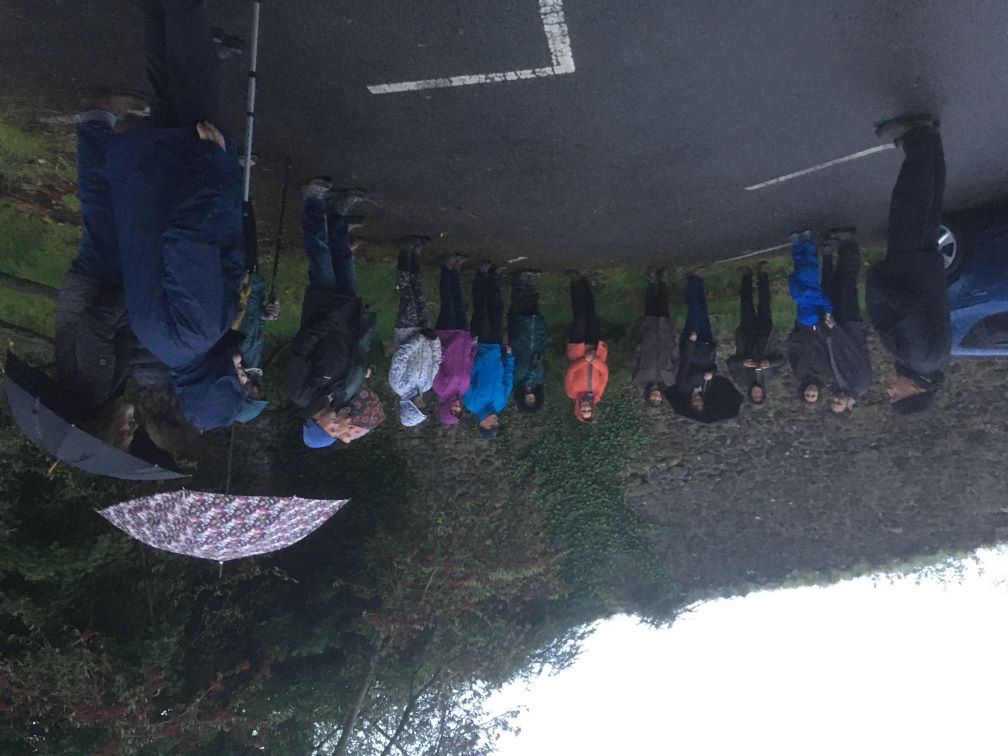
Starting in the carpark we heard Chaffinch, Robin, Great Tit, Hooded Crow, Wren, Woodpigeon, and Goldcrest. The jazz band like high pitch song of Goldcrest is beyond the hearing of older humans. A Mallard flew over. Unfortunately, the Great Spotted Woodpecker which had been heard drumming in recent times was silent and the Treecreeper seen previously did not show.
Shane explained that birds like woodland edges. To roost, hide and nest in the trees and feed in the open area. They also like to shout across the clearings as sound travels further.
(1)Male birds sing to declare a territory as well as attracting a mate. The first part of a wren’s song is directed against other males while the machine gun trill at the end is attractive to females. Wrens are polygamous with one male having several females “on the go” at once. Therefore, competition between male wrens is fierce hence their loud aggressive singing—The poet Michael Longley described it as “brain rattling”. On the other hand, bullfinches are monogamous and pair for life. No prolonged major competition between males so bullfinch song is very simple and quiet.
We moved into the yard area where there are what Shane described as “tired buildings” which are ideal nesting places for swallows, house martins and jackdaws.
In the wood we heard Song Thrush, Blackbird, Blackcap, Robin, Wren, Mistle Thrush, Coal Tit and Great Tit. Shane described the path through the wood as an ideal hunting area for Sparrowhawk. He explained the reverse sexual dimorphism of the Sparrowhawk where the male is smaller than the female so they can prey on different species and therefore not compete with each other for food. Indeed after he has completed his breeding duty the smaller male sparrowhawk has been known to become a meal for the female!
We turned down by the Lissan Water hoping to see the Dipper but with the recent rain the water was a bit fast flowing for the usual Dipper behaviour. We did see some guano on the bigger river stones and a flash of the Dipper flying down river.
Shane explained the Lissan Water rises and falls rapidly and is therefore not suitable for Kingfishers to nest in the riverbank where a rapid rise in river level can be disastrous.
The noise of a river makes listening for bird song difficult for humans and also difficult for the birds. The occasional bird that does sing there has to increase their volume and pitch so that other birds can hear. Similarly in towns with a lot of background noise birds sing louder to be heard by other birds.
We then moved to the now overgrown water turbine collection pond with the tree lined bank behind. This provides a natural amphitheatre and birds love to sing in this area as sound travels so well. And we humans can also hear birdsong more easily in such places. Again, we heard Wren, Blackbird, Song Thrush, Blackcap, Chiffchaff, Robin. A Mistle Thrush did a rasping alarm call. Shane saw a Lesser Redpoll. A Jay was heard in the distance.
We had a rest in the new sheltered educational area built recently by Ballinderry Rivers Trust. (1) We learnt that while humans have one voice box, birds have two—that is one in each bronchus. Birds can use each voice box alternately while breathing alternately through the other bronchus so birds can sing continuously viz the Skylark.
The human auditory system can appreciate sounds of a twentieth of a second while birds can appreciate sounds of a two hundredth of a second. Therefore, birds hear 10 times the number of notes heard by a human.
We walked to both the White Bridge and Harry’s Bridge but no Dipper’s were performing but we heard a good variety of woodland birds on the way there and back.
Back towards the house we came again to a clearing giving opportunity to hear Chiffchaff, Blackcap, Robin, Blackbird, Woodpigeon and Great Tit.
We returned to Lissan House and the ballroom where Sharon, Arnie and Pat entertained us to a welcome breakfast.
Our thanks to Shane for leading us on an enjoyable and educational walk despite the damp morning. We heard or saw a total of 18 bird species.
Our thanks to Sharon and Lissan House Trust for hosting us and providing breakfast.
We await with interest the results of the recordings by the BBC team.
Report on Dawn Chorus by Ernest Hunter
(1) Information from QUB Workshop by Mary Montague BSc. MSc. PhD.