
Translate
 Select
-
 English
-
Kiswahili
-
Afrikaans
-
هَوُسَ
-
Asụsụ Igbo
-
اَف صَومالي˜
-
Yorùbá
-
isiZulu
-
Français
-
Dansk
-
Svenska
-
Norsk
-
Íslenska
-
Suo̯men
-
Català
-
Cymraeg
-
Gaeilge
-
Deutsch
-
Galego
-
Nederlands
-
Euskara
-
Italiano
-
Español
-
Português
-
босански
-
Українська
-
Slovenski
-
Slovenčina
-
Srpski
-
Русский
-
Română
-
Polski
-
Lietuvių
-
Latviešu
-
Magyar
-
Eesti
-
Český
-
Hrvatski
-
Беларускія
-
Български
-
Shqip
-
Ελληνικά
-
Македонски
-
ქართული
-
বাংলা
-
ગુજરાતી
-
ພາສາລາວ
-
தமிழ்
-
Sinugbuanon
-
Монгол хэл
-
ភាសាខ្មែរ
-
Basa Jawa
-
मराठी
-
آذری
-
Հայերեն
-
اردو
-
Türkçe
-
Tiếng Việt
-
ภาษาไทย
-
فارسی
-
Bahasa Malaysia
-
조선말
-
日本語
-
Bahasa Indonesia
-
मानक हिन्दी
-
עברית
-
Filipino
-
漢字
-
汉字
-
العربية
-
Kannaḍa
-
తెలుగు
-
Hmong
-
नेपाली भाषा
18 members and guests attended our Fungus Foray at Derrynoid Forest on Saturday afternoon 18th October 2025. We were led by Jackie Arrell. We were very lucky to get a completely dry Saturday afternoon in some unsettled weather.
There had been a recent prolonged wet and unseasonably warm period of weather which led to a profusion of fungi this year. This is in contrast to last year when we had a dearth of fungi due to a prolonged dry spell in September 2023.
It is also a remarkable year for the profusion of acorns which were dropping everywhere and drumming on the roofs of our cars as they fell.
Read more: Fungus Foray Derrynoid Forest Saturday 18th October 2025
We had a general wildlife and bat walk at Cabin Wood on the evening of Wednesday 20th August 2025.
We were led by Mark Smyth. The recent very dry weather seems to have brought autumn in early. Despite only mid-August, horse chestnut and sycamore leaves are well turned to brown, conkers are well formed and there is a profusion of bright red berries on the rowan trees.
Read more: General Wildlife and Bat Walk Wed 20th Aug 2025 evening
Eight of us visited Donna Rainey’s wildflower meadow near Dunloy. We were met and led by Donna and her son James.
It was a special occasion on two counts. Firstly, we congratulated Donna on her recent award of an Honorary Doctorate by the University of Ulster for outstanding ecological work. Secondly, Saturday 5th July was International Meadow Day also known as National Meadow Day in the UK.
When we arrived lots of swallows and house martins wheeling about above the farmyard—they are nesting in the farm shed.
The lawn at the side of the farmhouse has been left uncut and lots of Yellow-rattle and Devil’s-bit Scabious were evident.
Donna took over the management of a five-acre field ten years ago. At that stage it was a field of barley under sown with ryegrass. Every year for nine years she has had the field cut for haylage late in the summer. No slurry or any other fertiliser applied so with successive mowing the field was gradually denutrified. They pulled the Ragwort out of the sward by hand. Initially there were a lot of docks which favour nutrient rich soil. They cut off the flower heads from the docks and year by year their numbers have decreased as the nutrient levels have fallen. Donna also pushed a sower over parts of the field distributing Yellow-rattle seed which germinates better if exposed to frost. She also plug-planted some Ragged-robin, Devil’s-bit scabious and a few Field Scabious.
Last year they stopped their annual cutting for haylage and instead grazed with Hereford and long-horn cattle and later ponies. Donna explained that cattle are best for a wildflower meadow as they graze non selectively and poach the ground helping wildflowers to set seed. Sheep are not helpful as they selectively graze the wildflowers in preference to grass and pat the ground flat and compact it such that wildlflower seed cannot set.
Read more: Donna Rainey's Wildflower Meadow Sat 5th July 2025
Fourteen members and guests attended Peatlands Park on Saturday 21st January 2025. We were led by Ian McNeill and Jackie Arrell.
On the walk up to the old Visitor Centre we were greeted by low flying swallows and Goldcrest singing. We noted Garlic Mustard, Sage, Hedge Woundwort and almost ripe cherries.
The Ranger informed us to look out for Large Heath Butterflies as 18 had been recorded a few days ago. Also to look out for Common Lizards that may be sunning themselves on the boardwalk.
At the border round the Education Centre, Ian and Jackie pointed out Red Valerian, Herb Robert with its distinctive nodes and branches, St John’s Wort, Pendulous Sedge, Bush Vetch, Wood Avens, Yorkshire Fog, False Oat-grass, Meadow Crane’s-bill, Yarrow, Smooth Hawk’s-beard, Shield Fern, Cut-leaved Crane’s-bill, Nipplewort, Common Dog-violet, Lady’s Bedstraw.
There were 28 members and guests on our coach party. After a welcome coffee stop at Dobbies Garden Centre Lisburn, we went on to Belfast Botanic Gardens where we were led by Colin Agnew Garden Team Supervisor who has been working at Botanic Gardens for 45 years.
In 1828 Belfast Botanical and Horticultural Society procured the land to set up Botanic Gardens. Their aim was to collect plants from round the world and encourage scientific research. The gardens back then were funded by admission charges and by running events such as fetes, concerts, sports, firework displays, hot air balloon rides and tight rope walks.
Read more: Coach Trip to Belfast Botanic Gardens and Colin Glen Forest Park Saturday 7th June 2025
Sixteen members and guests met at Car Park 2 behind Lough Fea on Sunday 18th May at 8.00am. The sand quarry is closed on Sundays and the whole area is peaceful except for the birds. We were led by Claire Hassan and Ernie Hunter. Our walk was a copy of one previously led by our late esteemed member Shane McGarvey who had studied the cuckoos at Lough Fea in depth and had detailed knowledge about cuckoos which he loved to share with us.
Shortly after we assembled a male cuckoo obligingly started calling from its usual perch in the beech trees along Spawell Road just behind our car park. Then another male cuckoo started calling further away to the north up Tullybrick Road. The Cuckoo previously heard in the region of the gravel quarry did not perform on Sunday morning but two males calling out of the three known to be in the area was satisfying.
Shane always said the Cuckoos came to Lough Fea every year by St George’s day (that is the 23rd April) The males make the well-known distinctive call. Cuckoos have a distinct shape when perched with wings hanging below the bodyline and tail cocked up. There are grey and brown morphs—the Cuckoos at Lough Fea are the brown morph. Cuckoos have the superficial appearance of a sparrowhawk and are often seen as a threat and attacked by other birds including the Meadow Pipit.
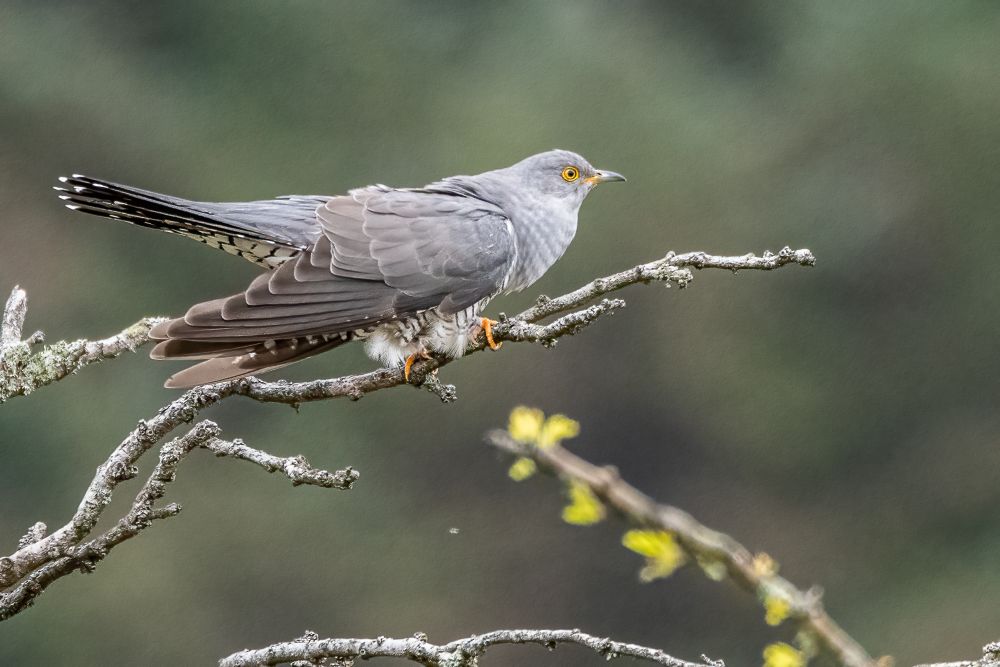
Male Cuckoo photo by Thomas Campbell
Male Cuckoos spend 6 weeks here calling, displaying, courting and chasing other males. While in pursuit flight males occasionally make an unusual leering call. After laying an egg the female sometimes makes a bubbling trill call.
Read more: Bird Song Field Outing Sunday 18th May 2025 at 8.00am
Thirteen adults and a toddler met on Saturday morning 16th November 2024 at The Strand Car Park at Long Point Lough Beg RSPB Reserve. We were pleased to have a window of fine weather.
From the car park we admired the herd of highland cattle and saw Golden Plover and Lapwing flying in huge flocks above Church Island. A snipe was seen landing amongst a flock of rooks quite near to us.
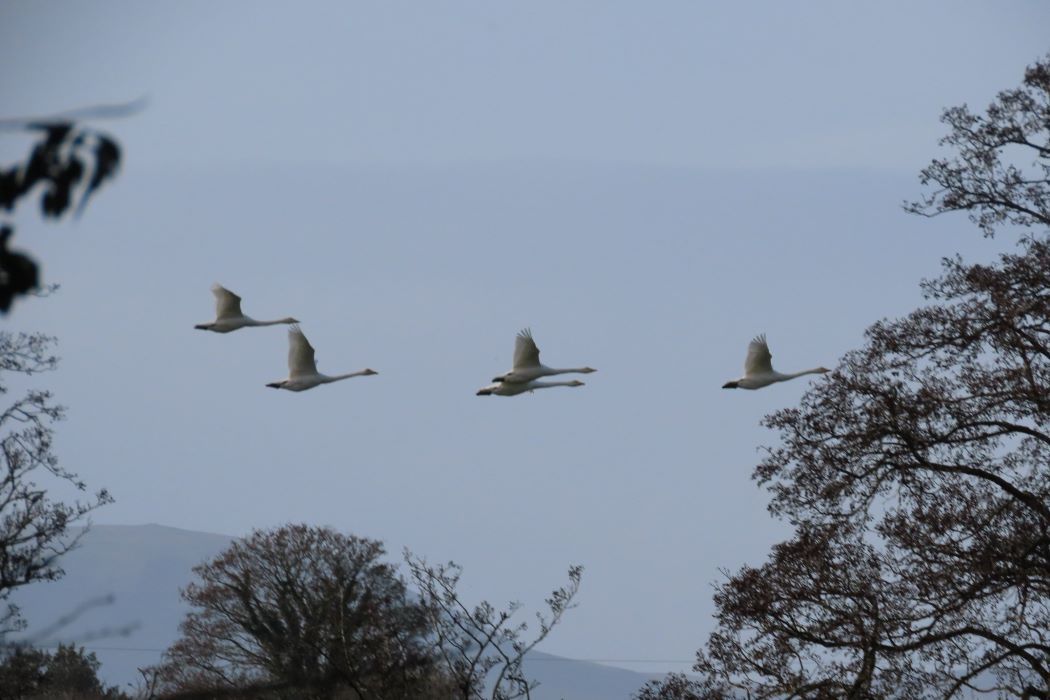
A flypast of Whooper Swans--photo by Donna Rainey
Along the boardwalk a Wren and Robin protested about our presence.
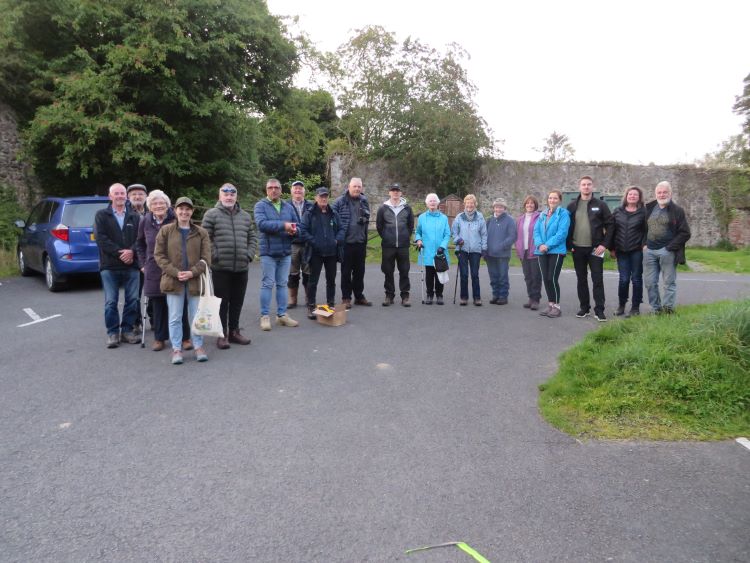
Sixteen members and two guests met at Lissan House Car Park on Friday 30th August at 8.15pm for a “Bat Walk” by kind permission of Sharon Loughlin and Lissan House Trust. We were led by Mark Smyth. This was our second attempt to hold this event having been forced to cancel 10 days previously due to rain and wind. But this time conditions were just right— dead calm, dry and reasonably warm.
We had the opportunity to try out our recently purchased bat detectors with Mark explaining how to use them to detect bat echolocation sounds inaudible to human ears.
Mark explained there are 7 species of bat in Northern Ireland and 8 on the island of Ireland. We do not have the Lesser Horseshoe Bat present in Southern Ireland.
England has 23 species of bat. Bat species account for 1/4 of all mammal species on earth being much more numerous closer to the equator.
Bats produce one pup per year born in May/June. At birth a pup can be 1/3 the mother’s bodyweight. As mammals they are of course suckled. The pups start to fly in July and may be seen flying with their mothers while being taught hunting skills. The pups become independent after a few weeks but unfortunately the majority of pups do not gain enough weight to survive their first winter hibernation.
Read more: Bat Walk at Lissan House Estate Friday 30th Aug 2024 at 8.15pm
Cookstown Wildlife Trust visited Mallon Farm on the Pomeroy Road on Saturday 20th July at the invitation of the owners Helen Keys and Charlie Mallon. The weather forecast was poor, and we came close to cancelling. However, we had a good turnout of 23 members and guests and 4 young people also attended.
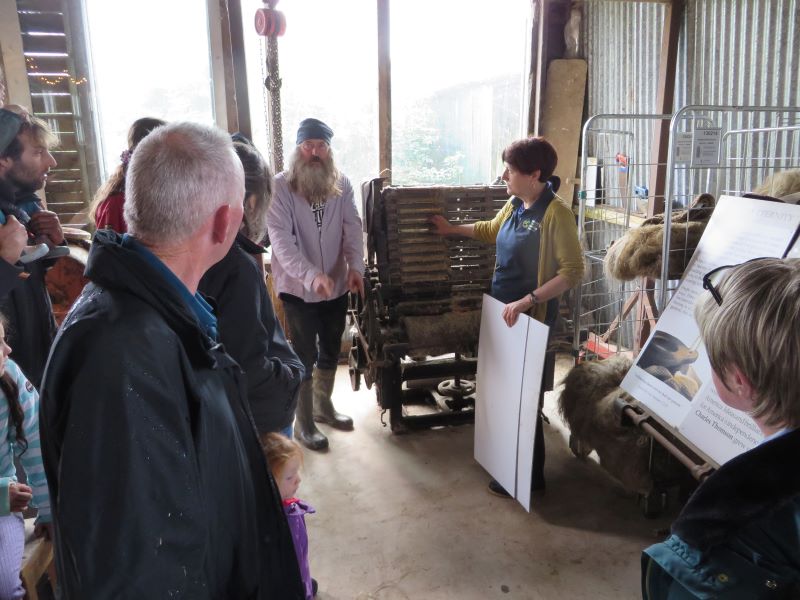
Charlie and Helen welcomed us to Mallon Farm
This is the Mallon Family farm which Charlie had inherited. Charlie is a bronze sculptor and was seeking linen cloth to wrap his sculptures but had difficulty accessing linen despite Ulster in the past having been the centre of an extensive flax growing and linen industry. Charlie and Helen then had the idea of trying to grow and process their own flax. Starting 7 years ago they now grow a field of flax every year, maximum of 4 acres per year. Flax grows best in heavy soil and must be grown in rotation as it draws a lot of nutrients from the soil which therefore needs time to recover. The ground is prepared and chain harrowed one month before sowing to knock the weeds back.
They sow flax with a traditional “seed fiddle” with the operator pacing up and down the field using marker posts as a guide. To ensure even spread of seed they then sow the field again this time pacing across the field. Best results are obtained by sowing densely at 3 bushels per acre (a bushel is a dry measure of volume and equals 8 gallons)
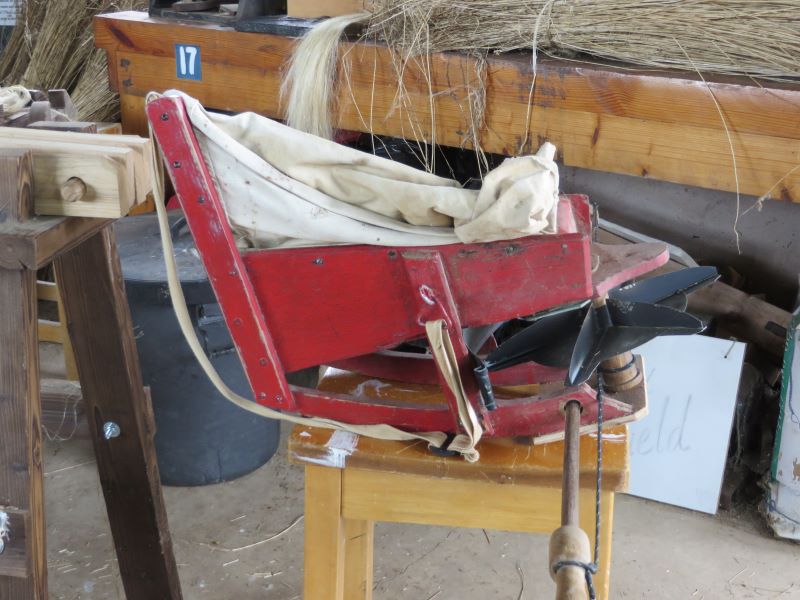
Seed Fiddle--used to sow flax seed
Sixteen members travelled to Portmore Lough RSPB Reserve on Saturday 29th June 2024. We were met by Warden Laura Smith who had placed a moth trap overnight.
We were impressed by the profusion of beautiful moth species she had trapped. Thirty -four species were identified including the impressive Elephant Hawkmoth, Poplar Hawkmoth, Garden Tiger, White Ermine and Swallow-tailed Moth. Then the ingeniously camouflaged Buff-tip which looks like a piece of broken twig and the Pebble Prominent which looks superficially like a pebble. Then others with intriguing names like Hebrew Character with wing markings like a letter from the Hebrew alphabet.
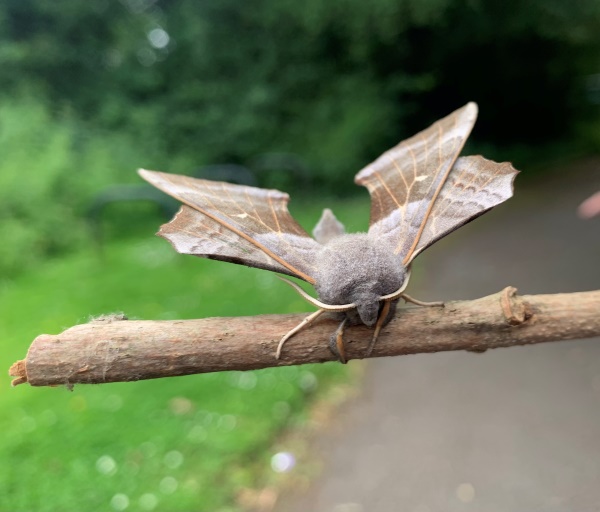
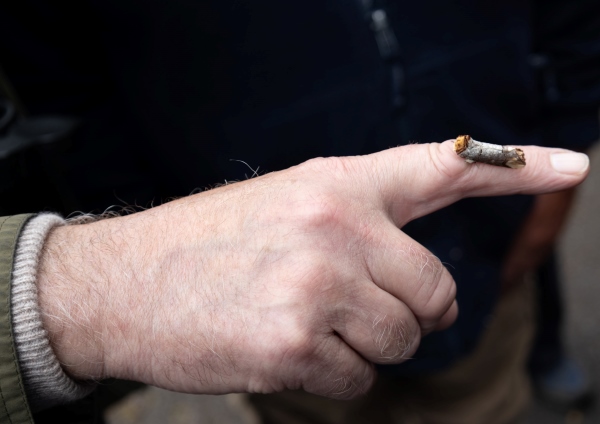
Poplar Hawkmoth Photo by Ida Cairns Buff-tip Photo by Michael Mullan
The full list of species is listed below.
Read more: RSPB Portmore Lough and Montiagh's Moss Sat 29th June 2024
Twenty-one members, one toddler and National Trust Ranger Ashley McLean met at Springhill National Trust Estate on the evening of Wednesday 5th June 2024. A wedge of polar air made its presence felt making it unseasonably cold. There was however only a light shower of rain.
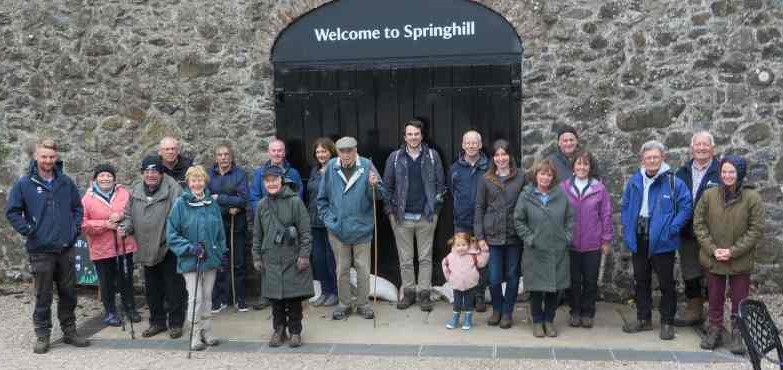
To start CWT member and previous Area Ranger at Springhill, Sophie Graham told us the history of the Wildflower Meadow. For decades the area had been mowed as a lawn. Then one day Sophie had a chance to see a map of Springhill Estate from 1862 and noticed a large area near the avenue marked as wildflower meadow. Sophie and her team decided to leave the area to grow again as a meadow. They asked a local farmer to mow the meadow once per year in the late summer, saving it for winter fodder but not allowing the use of any fertiliser. The Ranger Team was pleased to see a profusion of wildflowers appear. In particular Yellow Rattle appeared and spread. This plant parasitises grasses thereby stunting its growth and allowing other wild plants to flourish. There was so much Yellow Rattle that the rangers and volunteers were able to harvest the seed by hand (rather laborious) and sow it elsewhere in Springhill Estate and Wellbrook NT Estate to encourage wildflowers there.
At our wildflower walk on Wednesday evening we split into two groups. We were led by Jackie Arrell and Ian McNeill
Read more: Wildflower walk at Springhill NT Estate Wednesday 5th June 2024
Nineteen hardy adults and an equally hardy two-year old met in the car park at Lissan House on Saturday 4th May at 6.00am. We were led by Shane McGarvey. It was a damp drizzly morning but with no wind which is the main adverse weather condition if listening for bird song or birdwatching.
We were joined by Veronica and Matt from the BBC who are making a programme focusing on nature through the seasons at Lissan.
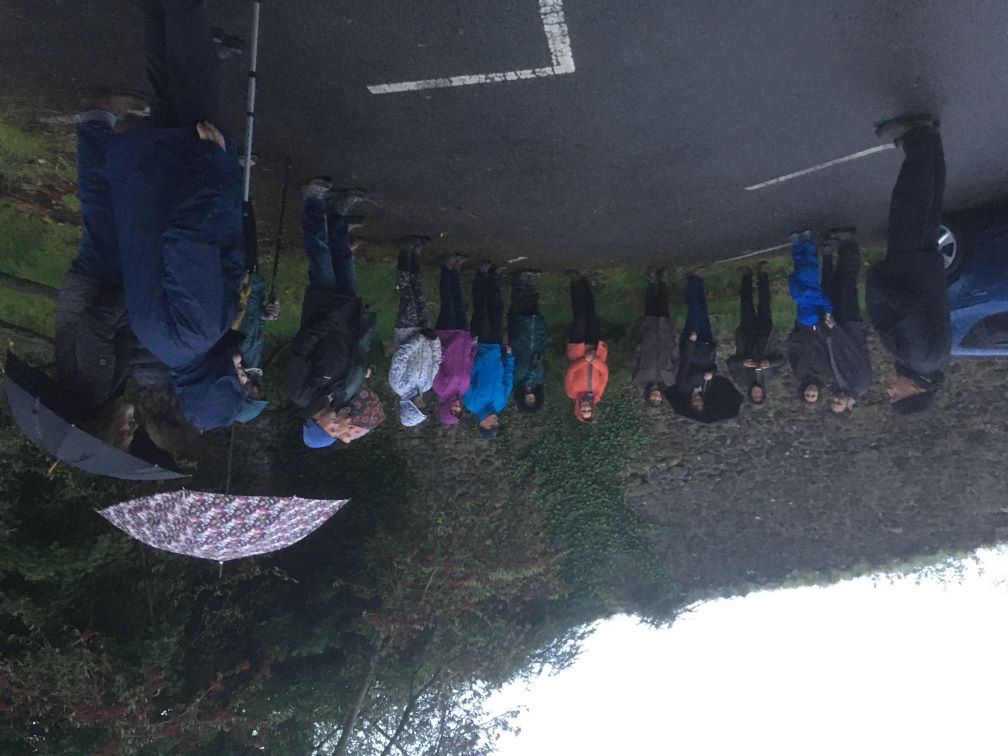
Starting in the carpark we heard Chaffinch, Robin, Great Tit, Hooded Crow, Wren, Woodpigeon, and Goldcrest. The jazz band like high pitch song of Goldcrest is beyond the hearing of older humans. A Mallard flew over. Unfortunately, the Great Spotted Woodpecker which had been heard drumming in recent times was silent and the Treecreeper seen previously did not show.
Read more: Dawn Chorus Lissan House Estate Saturday 4th May 2024
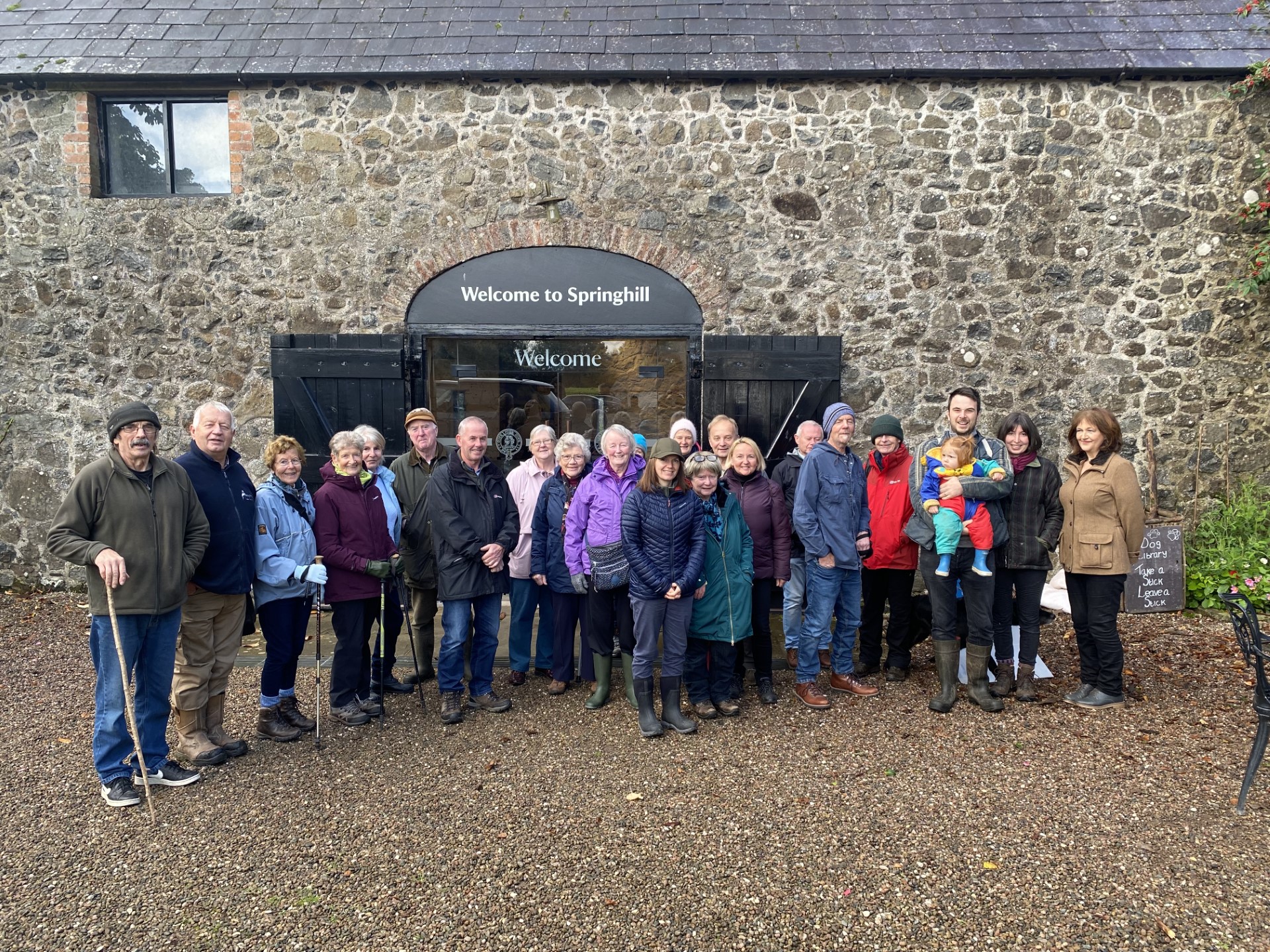
On Saturday 14th October, 26 people (25 adults and one toddler) visited Springhill, a National Trust property outside Moneymore, for a Fungi Foray. It was a bright, autumnal morning and we headed off into the woodland with our fellow member and expert fungi guide, Jackie Arrell.
The first species we encountered was the Shaggy Inkcap. Its fruiting body is usually torpedo-shaped but this particular specimen was well into the process of decay and a black slimy fluid full of fungal spores – ‘the ink’ was visible on the surface instead. In the 17th and 18th centuries, this black liquid could be used as an ink substitute. Later on in our walk, we found perfect examples of the Shaggy Inkcap as the white torpedo cylinders and as bell-shaped caps.
Only a few more steps were taken before more fungi appeared. There were remnants of Sulphur Tufts on the side of a tree stump and a fresh crop of Horse Mushrooms were found not far away. Jackie then came across some Common Puffballs and we were all entertained by the smoke-like cloud of spores which were ejected when the surface was compressed.
We were then shown a fungus with a very appropriate name – Artist’s Bracket. When the fresh white pore surface is scratched, visible brown lines are revealed that become permanent once the fungus is dried. It can therefore be a drawing medium for artists. Another aptly named fungus, Candlesnuff, was found close by on a dead branch and it closely resembled melted candle wax.
One of the most impressive species was that of the Collared Earthstar. Initially, they were well camouflaged among the leaf litter but once Jackie pointed them out, they were actually quite abundant. This species also releases its spores in a similar way to that of the Common Puffball.
Two fungi which are very alike in appearance are Dead Man’s Fingers and Dead Moll’s Fingers. Fortunately, we were lucky to see both and Jackie gave us a helpful identification tip. The latter has a much narrower base compared to Dead Man’s Finger and this was easily visible.
Fungi can be very dainty and delicate. A few dead branches were adorned with the beautiful yellow/orange Small Stagshorn. What a striking little fungus! Beside the Small Stagshorn on one of the branches was a miniature example of the gelatinous Purple Jellydisc - another impressive sighting.
There are many characteristics unique to each species of fungi. Jackie found an example of Woolly Milkcap and demonstrated how a milky substance is expelled when the gills are damaged. The upper part of this fungus also exhibits a wool-like texture!
Perhaps the award for the fungus with the best name would go to Lemon Disco. Jackie produced a large branch with hundreds of these tiny yellow cups. It was an incredibly colourful piece of dead wood!
The Honey Fungus was found in one part of the woodland on some dead wood. It can present itself like bootlaces, known as rhizomorphs, and are found underneath the bark. This fungus can be very destructive to trees, particularly because these rhizomorphs also travel underground and can spread up to 1 metre per year.
We tend to search the woodland floor for fungi but Jackie informed us that the Porcelain Fungus can grow in large tufts quite high up in Beech Trees. Sure enough, this was exactly what we observed. Some can fall from these heights onto the ground below. The smallest fungus of the day was also associated with the Beech Tree – the Beechmast Candlesnuff. This tiny fungus grows from the hard outer cases of Beech nuts. Well done to Jackie for finding us an example of this minuscule fungus.
It really was a fantastic fungi foray and many, many more species were encountered. Jackie’s knowledge of fungi is incredible and we are very grateful to him for leading this thoroughly enjoyable event. He really opened up our eyes to the wonderful world of fungi. Much appreciation is also forwarded to the team at Springhill for accommodating us. Many of the group enjoyed refreshments in the Springhill café afterwards.
Species List: Shaggy Inkcap, Horse Mushroom, Sulphur Tufts, Common Puffball, Artist’s Bracket, Candlesnuff, Collared Earthstar, Trooping Funnel, Mazegill, Common Earthball, Turkey Tail, False Saffron Milkcap, Woodpink Gill, Birch Woodwart, Pestle Puffball, Velvet Shank, Dead Moll’s Fingers, Small Stagshorn, Tawny Funnels, Woolly Milkcap, Earthy Powdercap, Meadow Waxcap, Purple Jellydisc, Lilac Fibrecap, Birch Bolete, Lemon Disco, Fairy Inkcap, Beechwood Sickener, Beech Milkcap, Hen of the Woods, Deceiver, Dead Man’s Fingers, Honey Fungus, Porcelain Fungus, Lilac Bonnets, Beechmast Candlesnuff, Clouded Agaric, Clustered Bonnets, Deer Shield, Smoky Bracket, Ochre Coral, Blusher, Glistening Inkcap, Lilac Fibrecap, Shaggy Scalycap, Blackening Waxcap, Beech Tarcrust, Sycamore Tarspot, Yellow Waxcap, Jelly Ear
Field Trip Report by Claire Hassan
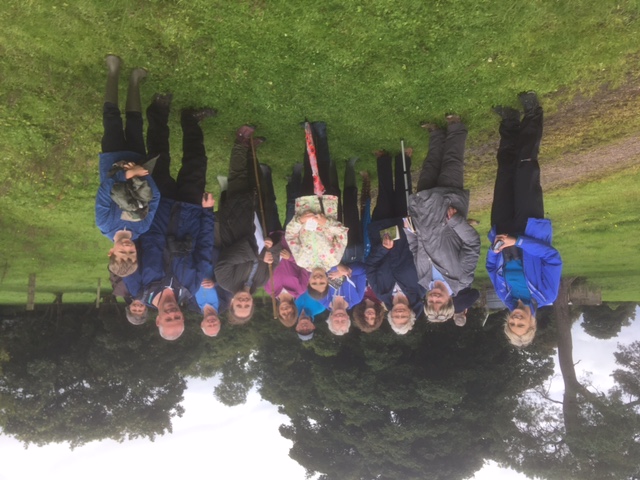
On Saturday 12th August 2023 a group of 15 members (12 adults and 3 young people) visited a private wildlife garden at Waterfoot Ballymaguigan by kind permission of the owners Henry and Kathleen Walls.
This is a 20-acre site extending down to the western shore of Lough Neagh, containing a mixture of woodland, scrub, a large pond and extensive margins where wildflowers abound. The area is easily accessible with mown grass paths throughout. We were self-led on this outing with members each contributing their botanical knowledge.
Despite being late in the wildflower season this site was as always prolific in the number of species seen. This was especially so along the side of the lake with so many interesting species there, an hour had slipped past and we had not progressed beyond the pond!
Species seen on our tour included lots of Red Bartsia, lots of Yellow Rattle, Common Centaury, Water Horsetail, Common Mouse-ear, Selfheal, Water Mint, Gypsywort, Smooth Sowthistle, Purple-loosestrife, Silverweed, Knapweed, Yarrow, St John’s-wort, Cut-leaved Crane’s-bill, Yellow Loosestrife, Red Dead-nettle, Shepherd’s-purse, Red Valerian, Colt’s-foot, Marsh Cudweed, Woody Nightshade, Field Forget-me-not, Marsh Woundwort, Hawkweeds, Greater and Lesser Bird’s-foot-trefoil, Yarrow, Greater Celandine, Fat-hen, Bulrush, Knotgrass, Greater Plantain (White man’s foot), Ribwort Plantain, Bogbean, Vetches, Lesser Stitchwort, Meadow Vetchling, Wild Angelica, Meadowsweet, Great, Marsh and Rosebay Willowherb, Hedge Mustard, Common and Marsh Ragwort, Meadow and Creeping Buttercup, Hemlock Water-dropwort, Giant Hogweed and the inevitable Himalayan Balsam now so common in the Lough Neagh basin.
A Whooper Swan, some Mallard, Black-headed Gulls and a Little Egret took off from a sandy spit a few yards offshore. Moorhen, Little Grebe, Robin, Heron and Wren were heard. Apart from swallows overhead few other birds seen or heard as we were visiting in August, a lot of birds are moulting and like to stay hidden. Furthermore, it was a little windy which is always the birdwatcher’s enemy.
Despite the wind Dragonflies were patrolling the edge of the pond. Without a net we could not identify the species. On the way round we regularly saw Speckled Wood butterflies as well as the occasional Peacock and Holly Blue. It has been a good summer for Holly Blues. A Cinnabar moth larva was seen on Ragwort.
Cookstown Wildlife Trust have visited this private wildlife area before. It never ceases to impress us. It is a truly remarkable wildlife resource and a credit to Henry and Kathleen Walls for conserving it in such great condition.
Field Trip Report written by Ernest Hunter
.
VISIT TO ANNAGINNY FISHERY AND PARK FARM THURSDAY 20th JULY 2023
On Thursday evening 20th July 2023 Alan and Charlene Abraham entertained 32 members of Cookstown Wildlife Trust showing us around their Fishery and Park Farm at Annaginny Road near Dungannon. We were amazed to hear that the whole area had been an open field 40 years ago. Over the years Alan dug out the 8-10-foot-deep lakes and planted extensive areas of native and non-native trees while recycling old classrooms to build bridges and recycled the old Desertcreat WI Hall to create a meeting room, reception and coffee bar. They now have a thriving fishery business and caravan park with up to 29 mobile and 14 static caravans with supporting facilities. In the lower part of the park there is a comfortable looking holiday home made from an old container. Alan also has an apiary with several beehives. He is the “go-to” man in Mid Ulster for anyone needing advice or support with “beekeeping”.
A summer school runs in a marquee in the park teaching arts, crafts, wildlife studies and countryside skills.
Annaginny Park is obviously managed with the conservation and welfare of wildlife as a priority.
One of the lakes is a remnant from a turf cutting bog which fuelled nearby Annaginny House-previously a hunting lodge for an aristocratic family from Donegal. Alan dug out the other two lakes.
The lakes are stocked with Rainbow Trout, Bream, Roach, Perch, Eels and Carp while Gudgeon appeared naturally. A couple of 20lb Pike keep one lake clean by removing sick and dead fish. Alan showed us a huge Sturgeon in a tank which he plans to release into one of the lakes. On the side of the bigger lake Alan has also created a sandy bank for Sand Martins to nest in.
Alan pointed out cultivated areas of Jerusalem Artichokes, Borage, Mustard and Sunflowers. Some of this is for his bees. As we went around several wildflowers were pointed out by Ian McNeill.
There are 500 Rook’s nests in the wood. Several years ago, with incentive from a government grant, Poplar Trees were planted to potentially supply a Belfast match factory. The factory closed prematurely and later in a heavy storm most of the shallow rooted Poplars were blown over into one of the lakes. A few of the Poplars remain. There are also several fine native trees including Scots Pines.
We were shown Red Deer, Wallabies (including an Albino), Emus, Rheas, Anglo-Nubian Goats, Jake the Donkey and a pen of “retired” racing pigeons and other fowl. A lot of the animals in the park have been “donated” by owners no longer able to look after them. These have included a Corn Snake, Macaws and a Terrapin.
We were shown a display of stuffed animals built up over the years as some “residents” have died off.
There is a remarkable larger than life polystyrene cow which has recently required protection with wire netting as Jackdaws have started pecking off pieces for their nests!
At the end of the tour we were entertained to light refreshments. The Chairperson thanked Alan and Charlene for a most interesting tour and congratulated them on how they were supporting wildlife at Annaginny.