


 English
Thirteen adults and a toddler met on Saturday morning 16th November 2024 at The Strand Car Park at Long Point Lough Beg RSPB Reserve. We were pleased to have a window of fine weather.
From the car park we admired the herd of highland cattle and saw Golden Plover and Lapwing flying in huge flocks above Church Island. A snipe was seen landing amongst a flock of rooks quite near to us.
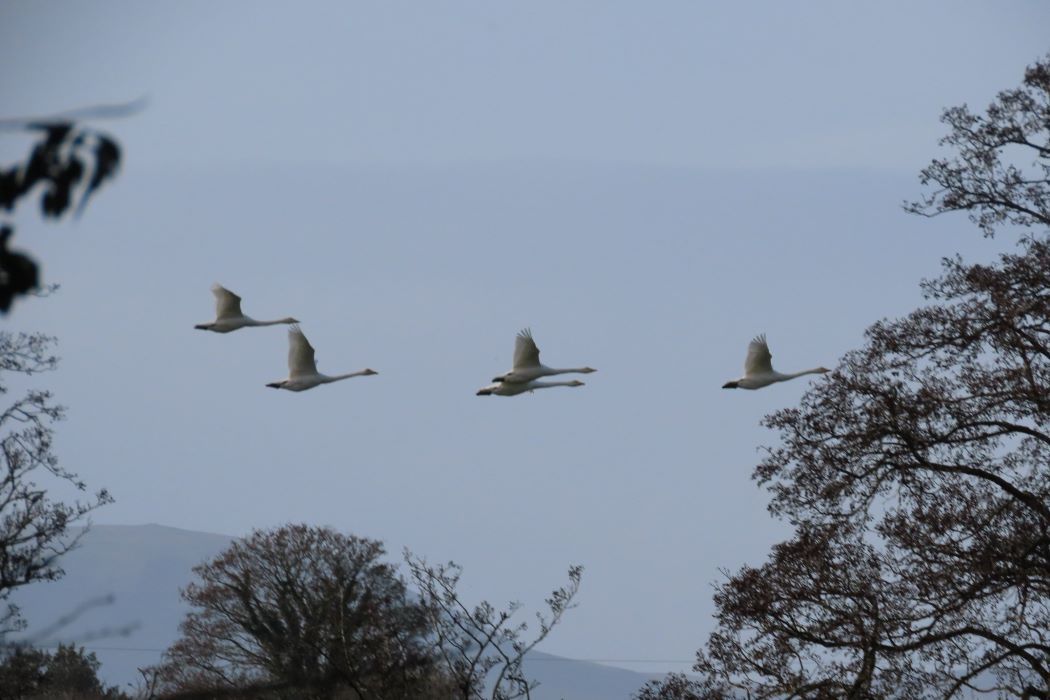
A flypast of Whooper Swans--photo by Donna Rainey
Along the boardwalk a Wren and Robin protested about our presence.
Jackie was busy on the grass either side of the boardwalk and in a few yards had shown us several fungi:-Heath Navel, Brown Mottlegill, Moss Bell, Alder’s Tongue, Candlesnuff, Deceiver, Moss Oysterling, Sycamore Tarspot and Pleated Inkcap all before we got anywhere near the wood.
Ballyscullion Park was in view and we stopped briefly to hear the unusual history of the area. How the Earl Bishop Hervey had built his second palace on the site starting in 1787 at the cost of £80,000. It was built in the form of a crescent with a huge dome and columns. He then had a spire built on Church Island—just to enhance the view. However, Bishop Hervey died in 1803 before Ballyscullion was completed. His heirs were unwilling or unable to keep Ballyscullion House and had it demolished in 1813! Then on the same site the Bruce family in 1840 built another “big” but somewhat less elaborate house "Ballyscullion Park". This is now run by the Mulholland family as a wedding and events venue complete with helicopter pad etc. The spire folly remains on Church Island with a slight tilt at the tip after being clipped by an American plane during WW2.
Returning to our outing—we proceeded into Long Point Wood—we noted the sign informing us that during the winter months wildfowlers shoot on this reserve. This stimulated some comment amongst us conservationists.
Dave Jewson pointed out that the low-lying fields between us and Ballyscullion Park are the site of diatomaceous clay deposits and are white when ploughed. Diatomaceous clay deposits are the fossilised remains of microscopic algae called diatoms deposited when the water level was much higher. In the past this clay was dug out at Toome on an industrial scale. It was used initially to make brick and in later years as an absorbent for nitro-glycerine to make dynamite, also used in toothpaste, cosmetics, fireproofing for safes, also as a sound proofing material, and to make electrical insulators.
Meanwhile Jackie and Donna continued finding fungi—on living wood, on dead wood, on leaves and on the ground.
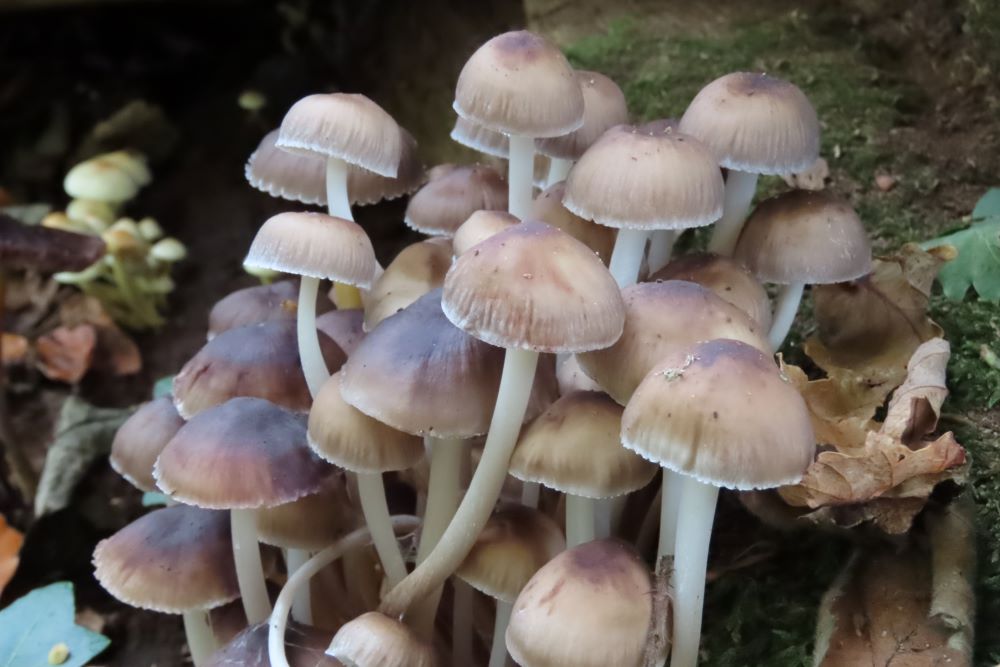
Clustered Bonnet :- Photo by Donna Rainey
Jackie found Birch Polypore and explained how a few years ago some hikers in the Alps saw a foot protruding from a glacier. Police were called. It was established that the deceased had been entombed in the ice for over 5,000 years! But also remarkably this nomadic neolithic man had Birch Polypore fungus in a small animal skin sack slung round his neck. Birch Polypore was used in neolithic times as an easily combustible material to help start fires.
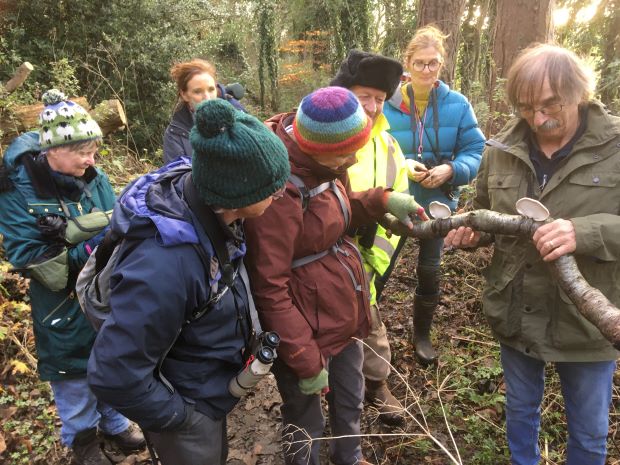
Jackie shows us Birch Polypore
We also marvelled at Dead Moll’s Fingers on a log. We learnt that Dead Moll’s Fingers have fine delicate bases to the fingers but Dead Man’s Fingers are the same diameter throughout the whole finger.
Clouded Agaric caught our attention not least because autumn 2024 has been remarkable as “bigger fungi” have been so late to appear this year due to a rather dry, cold September followed by a wet, warm October.
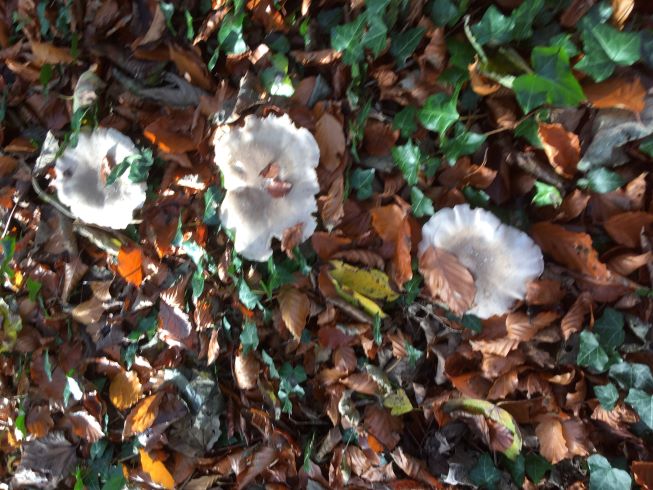
Clouded Agaric
The beautiful pure white Porcelain Fungus was a delight to view. It had fallen off a beech tree—it’s usual host.
Bootlace (Honey Fungus) was just waiting for Jackie to strip bark away to show it to us.
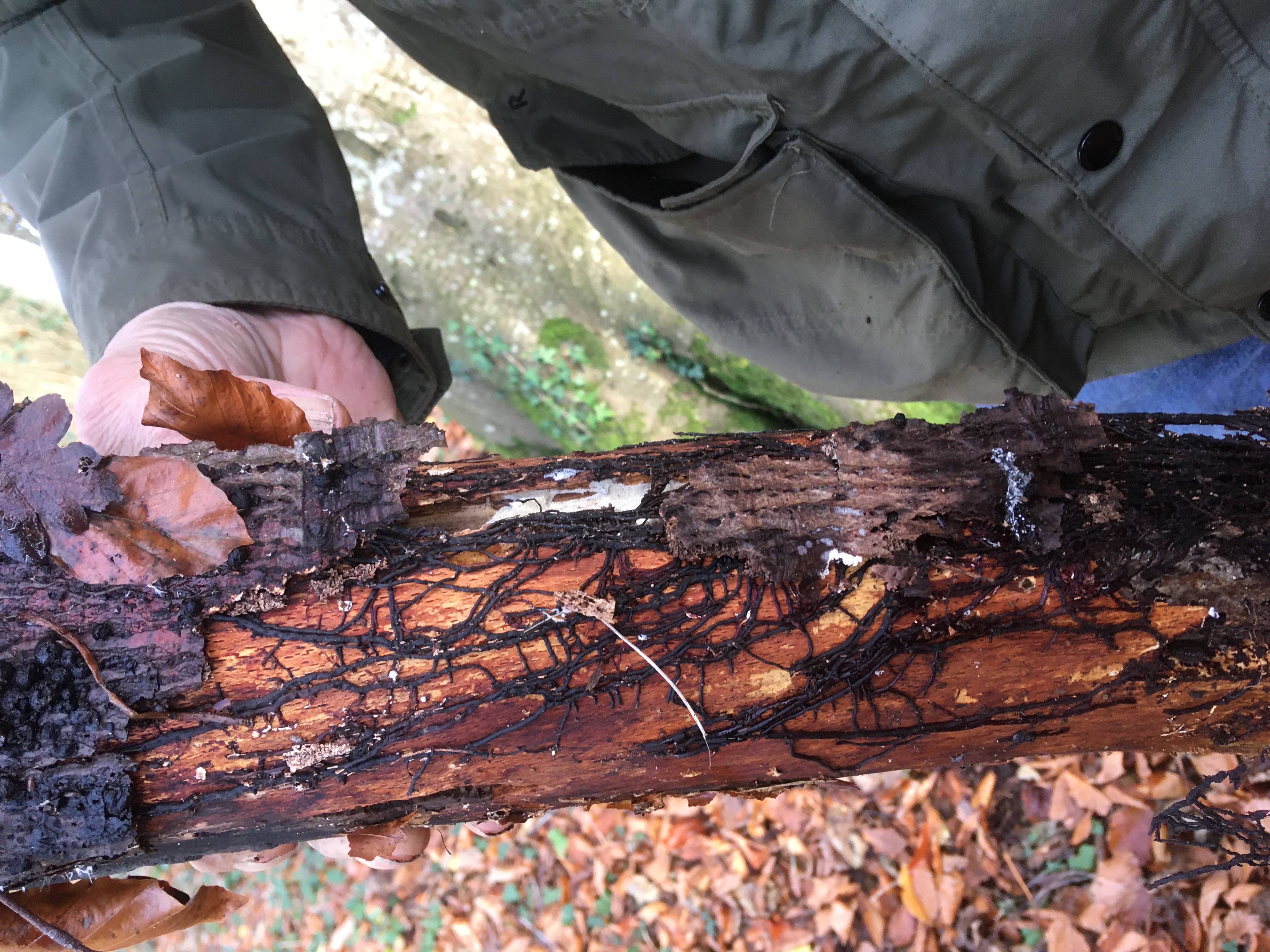
Bootlace (Honey Fungus)
On the walk Jackie and Donna found 47 fungal species –see complete list below.
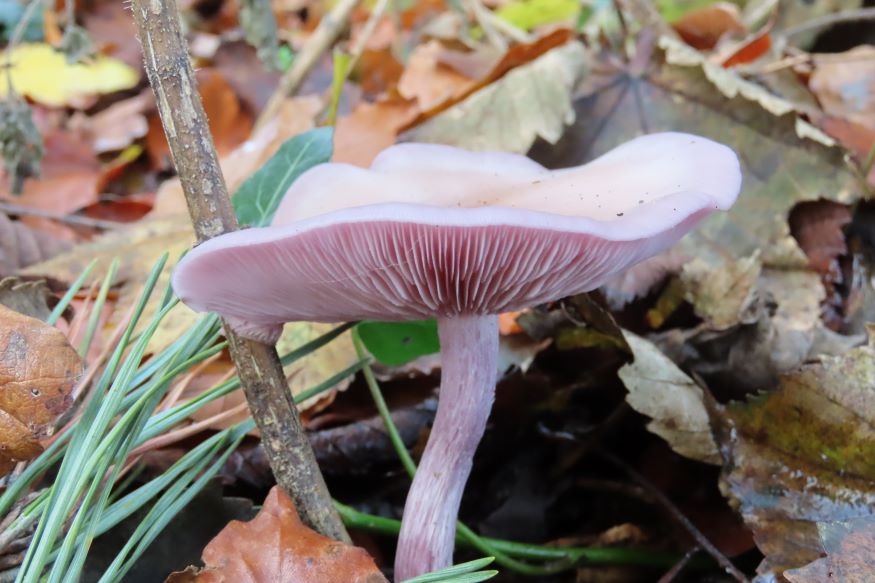
Wood Blewit --photo by Donna Rainey
On the way round the circular path and at Long Point in particular we saw numerous Lapwing as well as Widgeon, Teal, Mallard, Whooper Swans who did some spectacular flypasts and landings on the lough. Also Greylag geese, Mute Swans, Pintail, Little Egret. Meanwhile a huge murmuration of Golden Plover was again seen in the sky joined by hundreds of Lapwing.
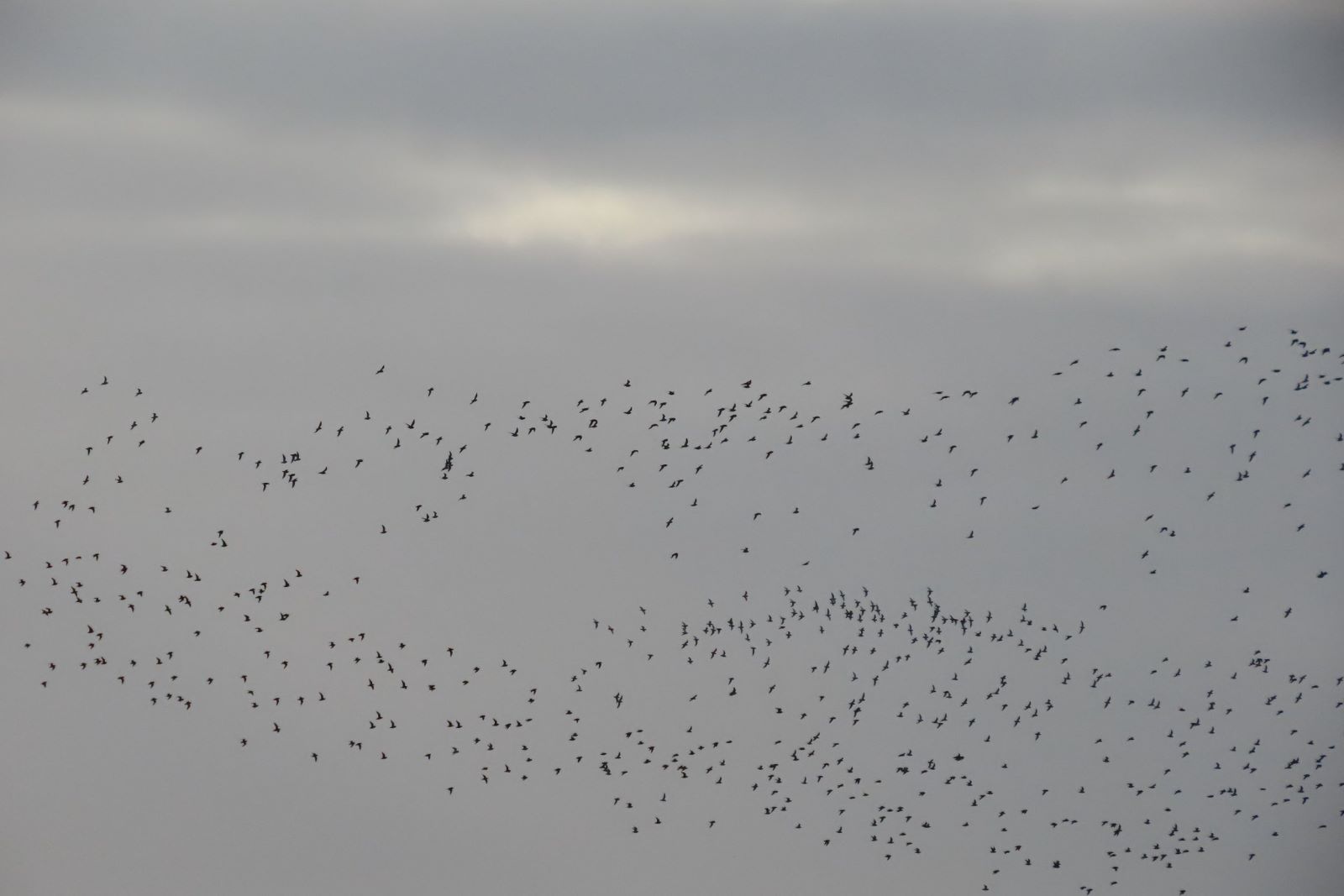
Flocks of Golden Plover and Lapwing over Lough Beg:- Photo by Donna Rainey
We looked carefully but failed to find any Ruff or any sign of the Great White Egret that had been recently reported on NI Birds.
At the Point a flock of Long Tailed Tits announced their presence with their high-pitched contact calls. Great Tit and Blue Tit were also seen.
On return along the boardwalk a helicopter took off from Ballyscullion Park and flew close by—the birds paid no attention!
Back at the carpark a male and female Stonechat were showing beautifully.
Thank you to Jackie and Alan for leading us on another successful outing. Thank you to Donna for the photographs.
Field Trip Report by Ernest Hunter
Fungus List Long Point Wood Sat 16th November 2024
Heath Navel Conical Brittlestem
Brown Mottlegill Clouded Agaric
Moss Bell Coral Spot
Alder Tongue Holly Speckle
Candlesnuff False Chanterelle
The Deceiver Hoof Fungus
Moss Oysterling Russet Toughshank
Sycamore Tarspot. Porcelain Fungus
Pleated Inkcap Small Stagshorn
Lilac Bonnet Pink Porecrust
Turkeytail Oyster Mushroom
Sulphur Tuft Beechmast Candlesnuff
Red Cracking Bolete Bitter Bracket
Puff Balls Beech Woodwart
Tawny Funnel Deer Shield
Jelly Ear Clustered Bonnet
Crystal Brain Velvet Shank
Wood Blewit Lemon Disco
Butter Cap Wood Mushroom
Beech Tarspot Ochre Coral Fungus
Artist’s Bracket
Variable Oysterling
Hairy Curtain Crust
Birch Polypore
Glistening Inkcap
Honey Fungus
Dead Moll’s Fingers