


 English
There were 28 members and guests on our coach party. After a welcome coffee stop at Dobbies Garden Centre Lisburn, we went on to Belfast Botanic Gardens where we were led by Colin Agnew Garden Team Supervisor who has been working at Botanic Gardens for 45 years.
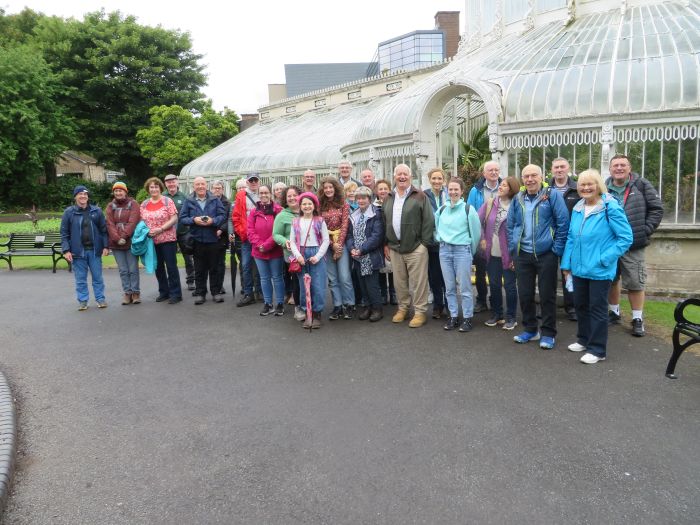
In 1828 Belfast Botanical and Horticultural Society procured the land to set up Botanic Gardens. Their aim was to collect plants from round the world and encourage scientific research. The gardens back then were funded by admission charges and by running events such as fetes, concerts, sports, firework displays, hot air balloon rides and tight rope walks.
The Palm House was designed by Lanyon, but his design was rapidly modified with the invention of curved glass by Turner of Dublin. The Palm House building was started in 1839. It predates similar glass house at Glasnevin and Kew built in 1844. It is now one of the most photographed buildings in Belfast. Colin said replacing a single pane of glass today costs £100.
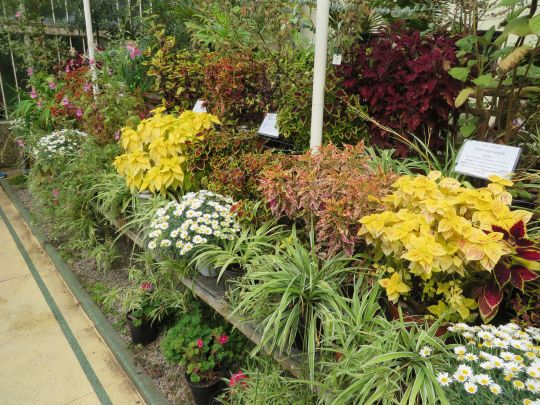
Colin initially took us to the cool temperate wing where there are spectacular seasonal displays of 30-35 different Coleus plants punctuated with other plants including medicinal plants. Also, a beautiful display of geraniums which have continued producing flowers after meticulous dead heading. There were spectacular vines, the roots being outside the glass house. Colin explained vines grow best with cold feet and a warm head but need a lot of feeding--traditionally on big estates vines were fed by burying a dead animal at the roots! We noted the pitcher plant with lots of dead insects being digested.
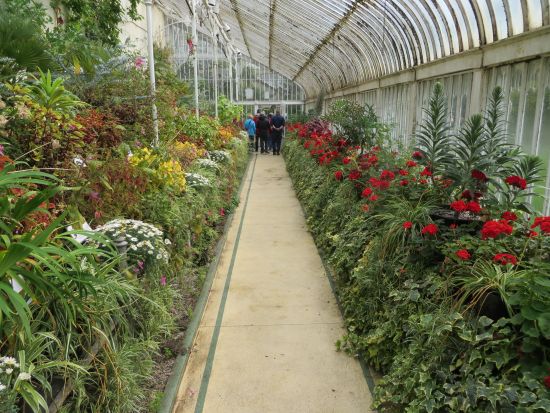
No chemicals are used inside the glass houses. Parasitic wasps are brought in to control the aphids.
The dome was added to the glass house in 1852 by Young of Edinburgh.It contains some spectacular species including palm trees, tequila plant and an Australian Sword Tree to name only a few.
Colin also showed us the stove wing with orange trees, banana trees, Swiss Cheese Plant which produces bread fruit and a very unusual fern like asparagus plant which is very vigorous and has to be curtailed from time to time.
The succulents in the glass house are the easiest to manage as they root quickly and provide a ready supply of back up plants. Succulents like a period of drying out between watering hence they are grown in clay pots and seem to thrive on neglect!
We were shown the blue plaque to John Templeton – the “Father of Irish Botany”. Born in 1766 he was a leading figure in the 18th century enlightenment. He had a collection of botanical specimens at his estate at Cranmore House. He discovered a lot of new botanical species including a hybrid wild rose named after him. This is now extinct in the wild but survives in Botanic Gardens. Templeton had been a great advocate of setting up Botanic gardens but died in 1825 before the purchase of the gardens.
The other blue plaque is to Charles McKimm Head Gardener/Curator at Botanic Gardens from 1877 who was responsible for developments including the Tropical Ravine built in 1889 initially to accommodate the Victorian obsession with ferns. He was also Curator when the gardens were bought by Belfast Corporation in 1895 after which public entry was free.
Colin showed us the Tropical Ravine explaining how this had been renovated over a number of years at a cost of £3.8 million pounds from Heritage Lottery and help from fund raising by the Friends of Belfast Botanic Gardens. It was reopened in 2017. Preserving the tropical plants during renovation was quite difficult using heaters and plastic cocoons. Keeping the plants relatively dry helped them survive the disturbance. A lot were repropagated from cuttings. One particular headache was the unique Killarney Fern. The sporophyte form of this was obvious, but staff had not realised that the floor of the ravine was covered in a mat of the gametophyte form.—there was no easy way to preserve this if the Tropical ravine was being stripped of its roof etc. Colin hit on the idea of transferring it to the old toilet block at the back of the gardens. This was damp and dark and the Killarney Fern thrived there and has been left in this now named “Bog Garden”
The Tropical Ravine was stripped down to the four walls. The original Scrabo Stone from Newtownards was sourced for repairs. The water cascade was dismantled with each stone numbered and ultimately replaced. The discovery of a 100 foot well in the floor of the ravine helped explain how there had been subsidence over the years!
We found the Tropical Ravine astonishing with the variety of tropical plants displayed so carefully. The Cycads from S. America and Australia are prehistoric (Jurassic) and look the part. They are incredibly slow growing and one specimen in the ravine is 300 years old.
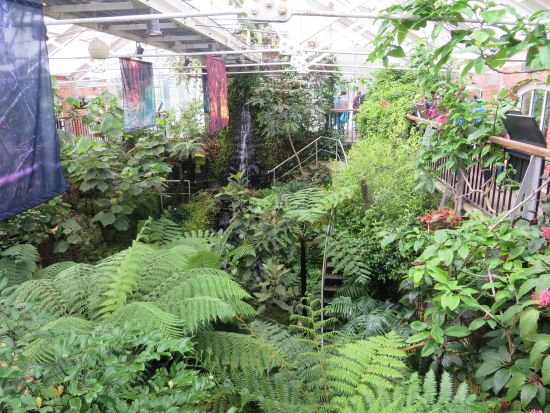
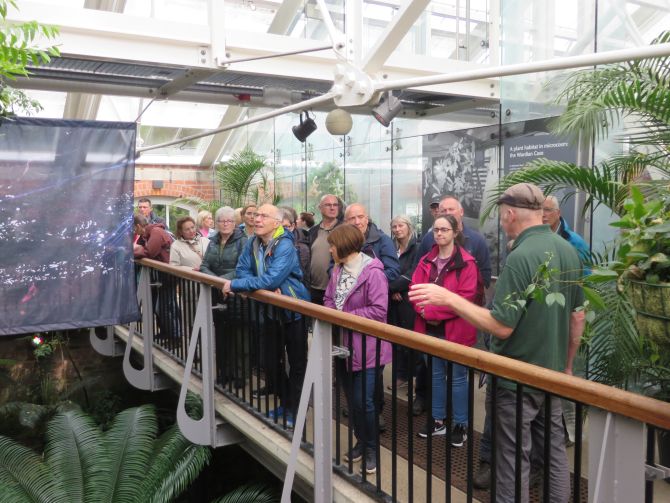
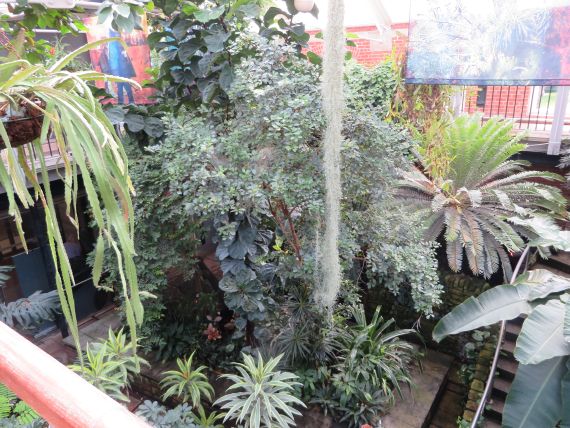
The new viewing gallery gives the visitor the vista of the cascade and lets one get up close to the banana tree. Colin pointed out the epiphytic pitcher plants which feed on cockroaches which abound in the ravine.
Colin pointed out the plaque with the list of previous curators including Forsythe Johnston from mid-1800’s who had a rather colourful family history and is an ancestor of the TV personality Bruce Forsythe.
Colin finished his part of the tour by showing us the Templeton Rose and the new Templeton Tree Trail where a row of specimen trees are being planted to remember retired staff.
Adrian Walsh and Barbara Pilcher from Friends of Belfast Botanic Gardens then took us round the Global Medicine Garden. The Friends group were formed in mid-1990’s, became a limited company in 2007 and gained charitable status in 2020. Their aim is to protect Botanic Gardens and preserve the historical features such as the tree collection.
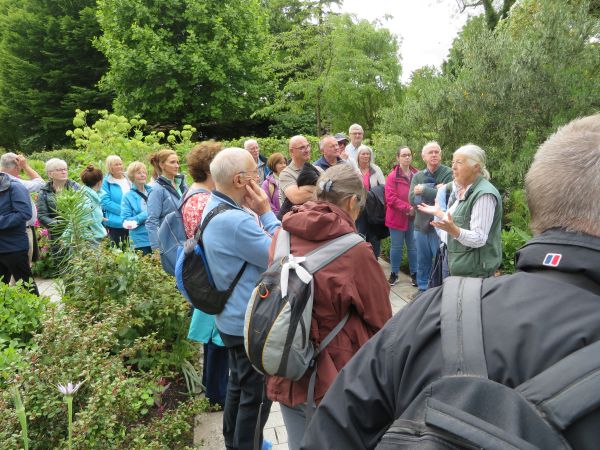
Barbara Pilcher led us round the Global Medicine Garden
They started restoring the Global Medicine Garden in 2019 on the same site where a previous curator Daniel Ferguson had a collection of medicinal plants in the mid-1800’s. Covid interrupted their project and then Brexit made it very difficult to bring in unusual plants from abroad. But they have now collected 160 medicinal plants which they have planted in Geographical Regions.
All cultures have plants that are used as remedies for common ailments such as headaches and fevers or herbal plants to treat diseases. Different plants in different countries are reputedly beneficial for the same complaint. However, university pharmacology departments and drug companies continuously research plants for possible cures due to the wide variety of phytochemicals that plants produce for their own protection some of which are beneficial for human and veterinary medicine. Some beneficial compounds have been found by chance. Madagascar Periwinkle was researched for use in diabetes but was noted to suppress white blood cell numbers. This was further investigated and the vinca alkaloids of Vincristine and Vinblastine have now been used for several decades in the chemotherapy of leukaemia and lymphoma.
We noted foxgloves (source of digoxin for heart conditions since mid-1700’s), valerian used as a sedative. Also, a multitude of different herbal teas including camomille, lemon balm etc. We were interested to see Woad used as body paint by the Celts going into battle. Coincidentally it has wound healing properties!
We were distracted by two field mice that had climbed up some plants and were feeding on the seeds. It is interesting the Friends do not use any pesticides or chemicals in the Medicine Garden but rely on predators to come in and control pests.
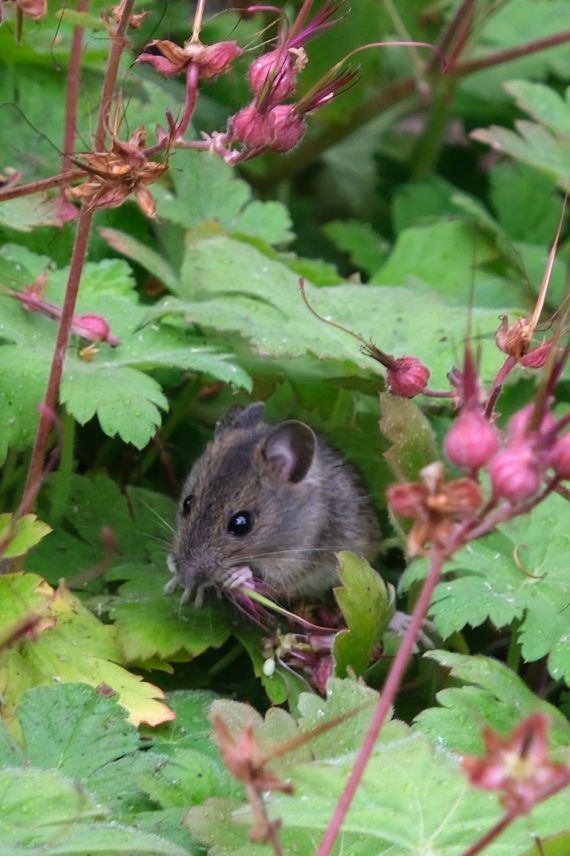
Mouse feeding on seeds in Global Medicine Garden Photo Kevin McKernan
We moved on to Malone House for lunch where we learnt a little about the history of the house and it’s owners including Viscountess Florence Harberton who was President of the Rational Dress Society in 1880’s promoting the idea of safer and more comfortable dress for women.
We moved on to Colin Glen Forest Park where Judy Meharg led us on a guided walk. Colin Glen is in the valley between Colin and Black Mountain. The Colin River joins the Lagan below Dunmurry. The glen has interesting geology with a lot of fossils regularly washed out of the Lias Clays when the river is in flood. In 1700’s it was an important site for the linen industry; the river being used for power and the river water for bleaching linen with extensive bleach greens in the adjacent fields.
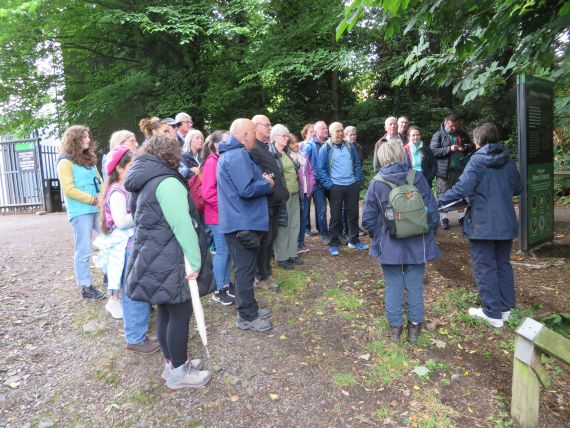
Judy Meharg led us round Colin Glen
Judy took us to all the native tree species and explained their importance to our ancestors in terms of their mystical and curative properties and their uses today. Each of 13 native tree species had a specific letter ascribed to it in the Ogham alphabet. Each tree species represented a particular period of the year Alder for March 18th to April 14th, Willow for April 15th to May 12th, Hawthorn for May 13th to June 9th This was Celtic Tree Astrology and somewhat similar to the concept of an astrological star sign today. Each person fell under a particular tree sign depending on their birthday and their personality was thought to reflect the “personality” ascribed to that particular tree species. For example, holly was the Ruler associated with bravery as holly wood was used to make weapons. So, someone born in the holly period of the calendar was destined to be a warrior leader.
Oak was the king of the forest. The druids regarded oak groves as deeply spiritual and oak trees connected to the underworld. Oak timber was much prized in later years for ship building, construction and barrels so widespread felling occurred. Oak bark was used in tanning. Oak galls were used to make ink. Oak is long lived and supports many other species of wildlife –up to 300 species.
Ash is the queen of the forest. Ash timber has multiple uses. 60% of all our native trees are ash and we saw the effects of ash dieback in Colin Glen. It is now so ubiquitous and devastating.
Alder wood when cut is orange/red like blood. The ancient Red Branch Knights had shields made from Alder.
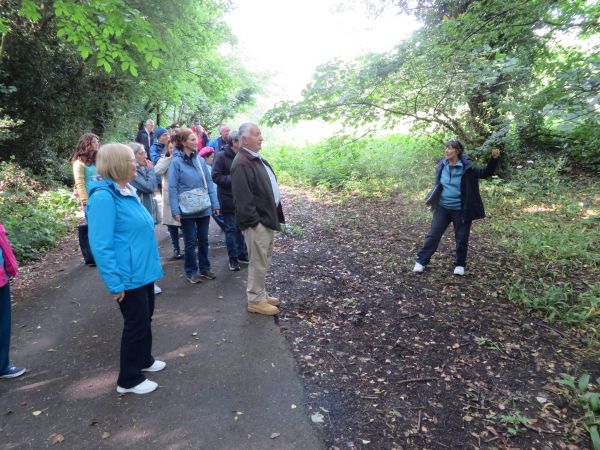
Judy Meharg explaining the mythology, folklore and use of trees
Willow is associated with grief but also fertility and jilted lovers while willow rods helped make good butter when churning. Charcoal from burnt willow was supposed to cure male baldness. The bark of willow contains salicylate the precursor of aspirin.
Hazel is a noble of the wood providing nuts and is associated with fertility and wisdom. Keeping a hazel stick at night would ward off evil. Sacred wells had hazel groves round them. Hazel could protect from snakes and there are stories of emigrants from Ireland to Australia taking bundles of hazel sticks with them to protect them from snakes.
Elder was associated with fairies the hollow stems being used by the fairies for flutes. It is inadvisable to fall asleep under an elder tree as one could wake up having suffered mischief. The flowers make good cordial and wine but one must ask permission from the fairies to pick them. The berries can be used to make jam.
And so, Judy gave us a comprehensive list of all the mystical and practical uses of our native trees.
We were grateful to our guides of the day Colin Agnew, Adrian Walsh and Barbara Pilcher at Botanic Gardens and to Judy Meharg for guiding us at Colin Glen.
Trip report by Ernie Hunter