


 English
We had a general wildlife and bat walk at Cabin Wood on the evening of Wednesday 20th August 2025.
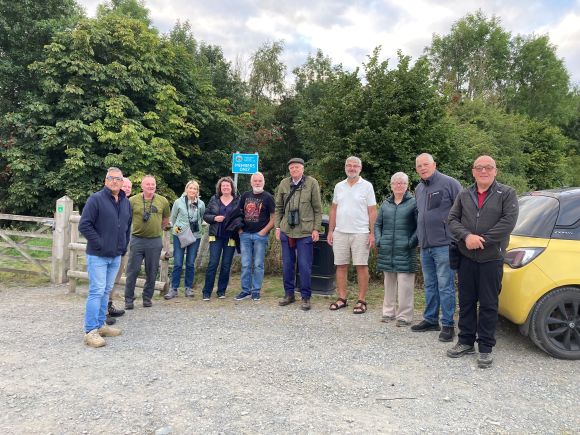
We were led by Mark Smyth. The recent very dry weather seems to have brought autumn in early. Despite only mid-August, horse chestnut and sycamore leaves are well turned to brown, conkers are well formed and there is a profusion of bright red berries on the rowan trees.
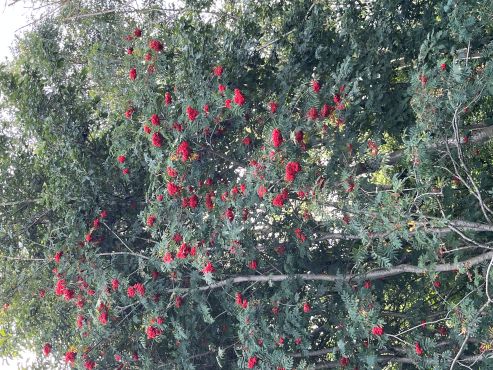
Rowan tree laden with berries mid-August
We heard bullfinch singing–a single plaintive almost monosyllabic sound from this monogamous bird as opposed to the machine gun trills of the polygamous wren.
A flock of long-tailed tits passed through, making their usual contact calls.
Ash-dieback is unfortunately very evident at Cabin Wood as at lots of sites in Mid-Ulster. Unfortunately introduced through infected ash saplings from Europe in 2012 and first found in Co Leitrim, it has spread through all of Ireland. Only a small % of ash trees are tolerant of ash dieback infection and it is anticipated this disease will cause major loss of ash trees in Ireland in the next 20 years. It is hoped disease tolerant ash trees will provide a “resistant gene pool” for the future. An infected tree has some years of life left and there is no need to cull infected trees unless they pose a danger to life or property. Rowan trees while known as “mountain ash” are not in fact from the same genus and thankfully are not affected by ash dieback disease.
We discussed the two types of oak tree. Pedunculate or English oak so called as the flowers and acorns are on stalks. But confusingly the leaves of pedunculate (English) oak have no stalks. The other type of oak found throughout Britain and Ireland is sessile oak—so called as the flowers and then acorns do not have a stalk but the leaves of sessile oak do have a stalk! Depending on where you are sessile oak have been called Cornish oak, Welsh oak and in 1990 Charles Haughey declared the sessile oak to be the national tree of Ireland. Oak trees support more wildlife species than any other species of tree whether native or imported. Oak timber has been used in house construction and ship building for centuries. It took 2,000 oak trees (100 acres of forest) to build just one of the ships like Agamemnon used by Nelson’s fleet. Oak was therefore regarded as a weapon of war so much so that Napoleon once sent two spies to England to try to burn down the Forest of Dean in England.
Mercifully sudden oak death fungus found in Ireland is a different strain from that found in North America but has infected large areas of larch trees in Ireland.
We heard dippers calling to each other but did not see them. Lots of woodpigeons were calling. The Ballinderry River was quite low and slow flowing due to the recent dry weather. It was covered in thousands of pond skaters (water striders). We noted the Carboniferous limestone rocks along the banks.
We also noted that despite being mid-August, hedge mustard, marsh ragwort, some vetches, great willowherb, and meadowsweet were still in flower. We saw the poisonous “Lords and Ladies” and mused over the many common names for this plant—some not repeatable here. Mark demonstrated the marzipan smell of meadowsweet flowers. We noted wood avens, rosebay willowherb, nipplewort and bluebells in seed. Mark told us how the humble buttercup supports populations of golden micromoths. We noted enchanter’s nightshade in flower.
As darkness began to fall we briefly detected Leisler’s bats echoing at 25 Hz—they are our largest bat, emerge first in the evening, fly high and can be mistaken for birds.
In a gap through the trees where electricity wires cross the river there was significant activity heard and seen from common pipistrelle at 45Hz and soprano pipistrelle at 55Hz. Mark referred to common pipistrelle as the “countryside bat”, it roosts in trees behind ivy, while soprano pipistrelle likes the comfort of insulation in the roof space of houses. He also explained about the feeding buzz heard with our bat detectors as a bat approaches and catches its prey. This is described as like a zip fastener being pulled up quickly.
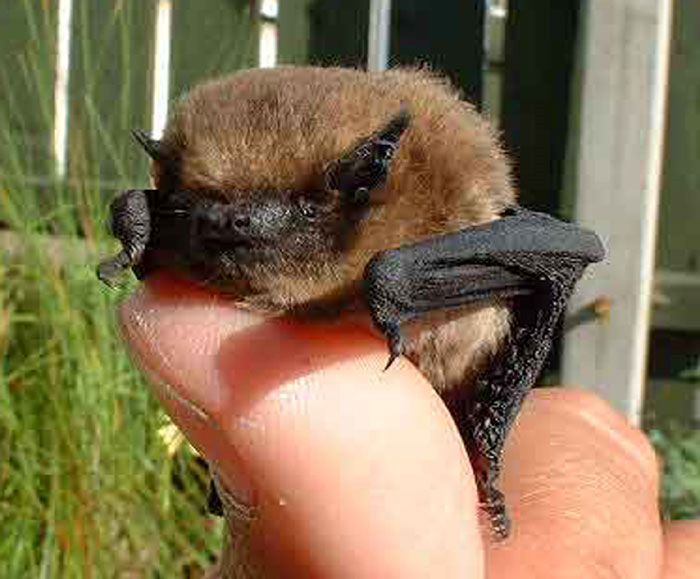
Common pipistrelle or "countryside bat".
Further along the river we heard activity from Nathusius’ pipistrelle at 43Hz.
Standing on the river bank with the aid of torches we were able to see Daubenton’s bats flying in a figure of 8 hunting over the surface and occasionally dipping into the water. Mark pointed out their pale bellies as they wheeled and turned. They also echolocate at 45Hz but with a distinctive rhythm from other species.
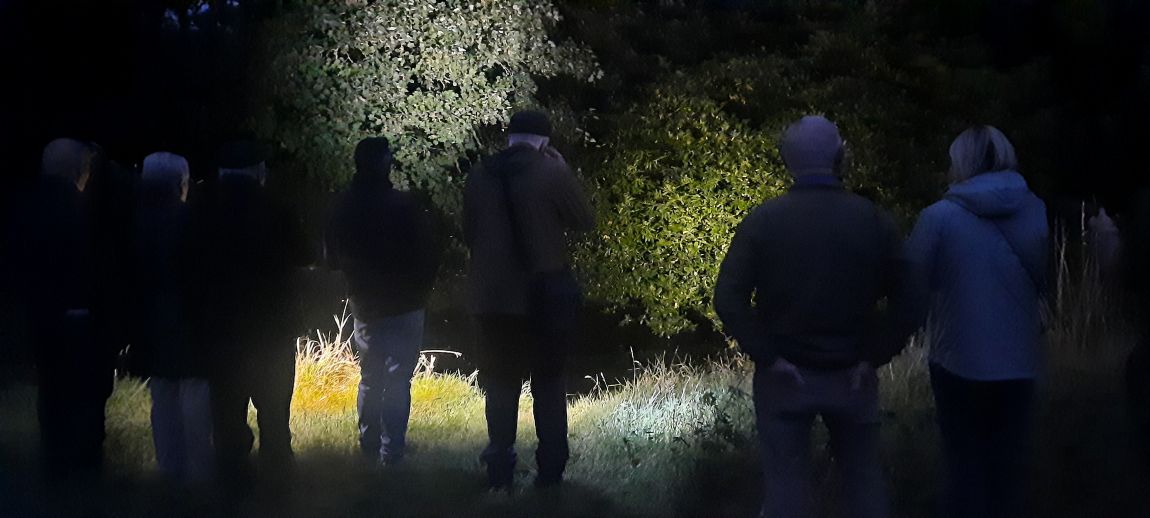
Watching Daubenton's bats along Ballinderry River Cabin Wood
Mark reminded us that bats are mammals, mate in the autumn but that females delay their pregnancy until spring when they bear 1-2 pups. Bats can drop their temperature from 40 Centigrade in summer down to 3-5 Centigrade during hibernation in winter. Our bats hibernate in north facing roosts to avoid waking up inappropriately on a warm day in winter. Unfortunately, if they wake up during an unseasonably warm spell in winter it can cause them to fly out of the roost and start hunting. This uses up vital fat stores and can compromise their survival.
A single bat can consume up to 3,000 insects in a night. Some can travel 10 miles on a single night in search of food. Mark told us marking and tracking studies have revealed some pipistrelle bats have crossed the English Channel and even the North Sea.
We were pleased that we detected five of the seven Northern Irish bat species at Cabin Wood and will pass this information on to the Woodland Trust. We are very grateful to Mark Smyth for leading us on an interesting and successful walk.
Report written by Ernest Hunter Chairperson