


 English
On 12th September 2023, Chairperson Dr Ernie Hunter welcomed a large attendance of 50 people to our first Cooktown Wildlife meeting of the new season held, in Desertcreat W.I. Hall. The speakers for the evening were Ric Else and Hazel Watson whose talk was on “Rathlin Island’s special species from seabirds to ladybirds and butterflies to butterworts”.
Self-confessed “nature nerds” they came to the Island in 2017 with the objective of recording as many species of plants and animals as they possibly could. To date they have recorded over 1400 species of plants and animals. These include many rarities. The Golden Hare is a rare genetic variant of the Irish Hare which inhabits the island. They have pale blonde fur and bright blue eyes. First recorded in 1970, the golden hare is a rather elusive creature and difficult to find. In 2019 six were spotted, but this year only one has so far been seen.
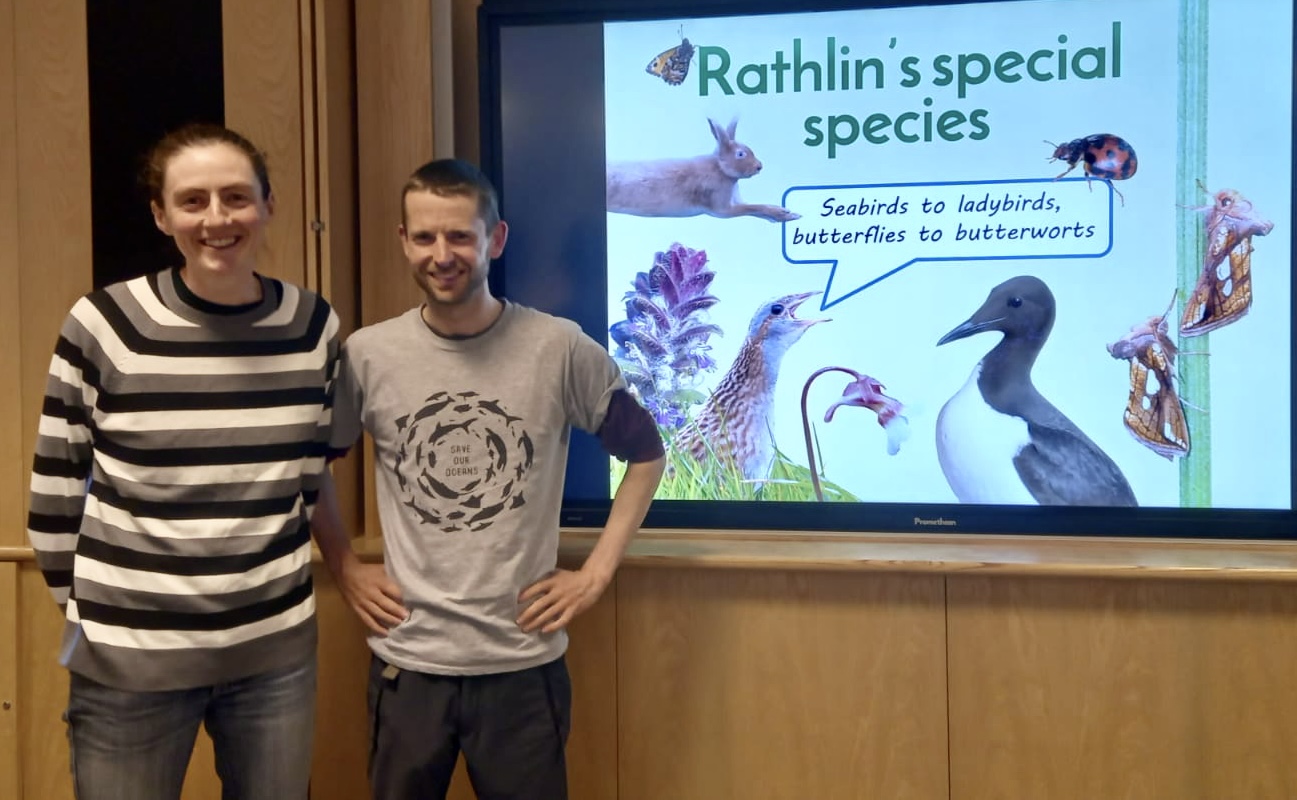
Ric Else and Hazel Watson whose talk was on “Rathlin Island’s special species from seabirds to ladybirds and butterflies to butterworts”
Rathlin is the only site in all of Ireland were the Lempke’s Gold Spot Moth lives. Other Moth rarities found are the Dotted Carpet Moth which lives on lichen covered trees, the Chestnut Coloured Carpet moth and Caryocolum Vicinella, a sea cliff and coastal species .The Island is also the home to the 24-spotted Ladybird. This very small velvety ladybird differs from many other ladybirds in not being an eater of aphids when an adult. It feeds on the abundance of Sea Campion. The Grayling Butterfly is widespread, loving the bare rocky cliffs of Rathlin. The Green Hairstreak and the Holly Blue Butterflies can also be seen.
Interestingly the Island has six species of Carder Bees including the Moss Carder Bee. Not to be confused with the Common Carder Bee this species loves grassland, rich in flowers especially Devil’s Bit Scabious.
There are 500 known Vascular plants on Rathlin. Vascular plants include Clubmosses, Ferns, Horsetails Gymnosperms and Angiosperms (flowering plants) One of the rarest plants to be found is the Pyramidal Bugle. Rathlin is the only place in Northern Ireland where it grows and 700 sites on the island have been counted so far this year. It flowers early and by June is almost over. The Oyster plant is a member of the Borage family and can be listed as vulnerable. It is found on the island in one place only, on a pebbly beach. It has grey green slightly succulent foliage with purple flowers in the Spring and Summer. It is almost prostrate and forms mats on the shingle. Being a Perennial, during Autumn and Winter it disappears only to reemerge the following spring. Carnivorous plants are also to be found Examples of these are the Common Butterwort, the Round leaved Sundew and the Pale Butterwort. An exciting discovery was made when a potential new species of Stonewort was discovered by Ric and Hazel. These plants are very ancient and are a family of complex-structured algae. They live in a variety of wetland and freshwater habitats This “new “species has been sent to a German specialist on Stoneworts for more detailed analysis.
Fungi are common on the island 28 species of Waxcaps from the colourful Parrot Waxcap to the pink Ballerina Waxcap have been noted. As Waxcaps are under threat from destruction of their natural grasslands Rathlin is a very important site for these mushrooms. Rathlin is renowned as a “stepping-stone” for migrant birds. Birds, such as the Ring Ouzel, the Yellow Browed Warbler, the Tree Pipit and even White Tailed and Golden Eagles can often be seen. Rare vagrants which occasionally have been recorded are for instance a Red Eyed Viceo from North America and a Black Stork from Europe. The good news is that Corncrakes are slowly making a comeback on the island. This year three males were heard and seen. April and May are good months to observe these birds as the vegetation is low. Hopefully the Corncrake can be re-established as a breeding species.
It is difficult to think of Moths migrating from faraway countries, but they do and will sometimes stop at Rathlin. These include the Striped Hawkmoth from Africa and parts of Europe and the Hummingbird Moth from the Mediterranean.
A vagrant insect that occasionally has been recorded is the Emperor Dragonfly from Africa. It was seen in October 2021 and was a first for Northern Ireland.
No talk on Rathlin could be complete without mentioning the Seabird Colonies. Ric and Hazel noted that there were over 25,0000 nesting seabirds. Most are Common Guillemots and Kittiwakes and then smaller numbers of Puffins, Black Guillemots and Shags. Puffin numbers in 2021 were 400. In 2023 over 1000 puffins were counted making it the biggest colony in Northern Ireland. The population of Shags is approximately 70 breeding pairs. This is also the biggest colony to be found in Northern Ireland. Unfortunately, Fulmar numbers. are down. The reason is yet unknown. The Kittiwake population remains steady and is recorded as the number two colony in Ireland and Great Britain. In 2021 over 20,000 pairs were counted.
Razorbills numbers also are roughly 20,000 and it is also the number two colony in Ireland and Great Britian. The colony accounts for3% of the world’s total Razorbill population. Also impressive is the Common Guillemot on Rathlin. It is the number one colony in Ireland and Great Britain. All the seabirds mentioned have been affected by Avian flu but, despite this, most of the colonies are doing well.
The talk ended with dramatic footage of young 3-week-old seabirds leaving the security of their colony and jumping from the cliffs into the sea. This spectacular event can best be seen in July evenings when the cliffs are full of “jumplings”.
Claire Hessin gave the vote of thanks and complimented Ric and Hazel not only on their dedication and passion but also in the amount of physical and mental work that is required to do this very important work on Rathlin’s flora and fauna.
To find out more visit their website rathlinstickybeak.wordpress.com.
Lecture Summary above by Maureen Graham Honorary Secretary