


 English
 March is the traditional month when hares go crazy! If you are lucky enough you may see them dashing after each other or getting up on hind legs and engaging in boxing matches. This is courtship behaviour. The boxing matches are between a male and a very angry female trying to fight of his advances!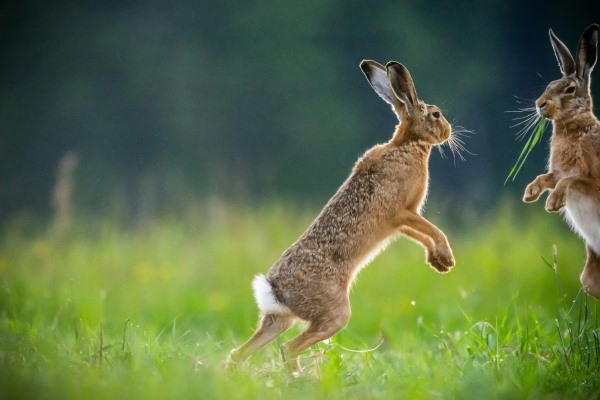
Hares boxing
Northern Ireland is home to both the Brown or European Hare which was introduced to Ireland in the mid to late 19th century and our native Irish Hare which is one of Ireland’s few native mammal species. In Mid Ulster the Brown hare has largely replaced the Irish species and there is evidence of the two interbreeding which is a problem as the Irish hare is unique to these islands. Originally thought to be a sub species of mountain hare there is now also evidence which supports the feeling that the Irish Hare should be given species status.
The Brown and the Irish hare can be distinguished from each other by the Irish hare having shorter ears, a pure white tail without a black upper side and often whitish grey flanks. Unlike other mountain hares in other countries, it mostly stays brown all year, On Rathlin Island a small population of Irish hares have a golden variant with blue eyes and pale blonde fur. When animals become isolated on islands any mutations that may occur, in this instance golden colouration, can become established in the small gene pool. As yet more research has to be done to discover if for instance two golden hares can produce golden offspring, if they have impaired vision because of their blue eyes and if they are more likely to be predated than their normal brown cousins.
The animal which resembles the hare is of course the rabbit and many people get confused by the two. Rabbits are completely different both physically and, in their behaviour, they are stockier, smaller with shorter ears, shorter legs and are much slower than hares which can reach speeds of up to 45 miles per hour. This makes them one of the fastest land animals in the world! They can also jump up to 10 ft in one single bound which they often do during courtship. No wonder they are called Mad March Hares!
Hares are nocturnal and prefer habitats like large open fields with scattered bushes and hedges. They can also be found in meadows, mountains and even seashores where they graze on seaweed. Like rabbits they are herbivores and eat only plants. They especially enjoy young grass, leaves and the bark of trees. They have a special digestive system which allows them to get as much nutrients as possible from the vegetation. They excrete and eat soft green droppings which still contains many undigested proteins and minerals. When these are eaten, they then excrete the hard dry pellets which we can see on the ground These have no nutrient value as the hare has extracted all the vital nutrients.
Females are larger than males. They breed in their second year. Young hares are known as leverets and are born in a shallow depression of grass called a form. Unlike rabbits they are fully furred with their eyes open and can fend for themselves almost immediately. Four to eight babies are usually born. It is very sad to think that 75% of all leverets will die within their first year.
Hares are mainly solitary but may be seen together in groups when feeding and during the breeding period. A collection of hares is known as a ‘drove’ ‘husk’ or a ‘down’ At one time large numbers, up to 300, could be regularly seen at the old airport at Nutt’s Corner, Belfast. They were safe from both predators and hunters at the airport.
Adult hares could in theory live for 12 years but 3 or 4 years is more likely. Unfortunately, they have many predators from foxes and stoats to birds of prey such as buzzards and falcons. Domesticated dogs and cats and of course humans also kill them.
They have been in decline since the early 1900 owing to changes in farming practices especially mechanised grass cutting. Persecution for sport may also have had an impact on their numbers. Hare coursing is now banned in Northern Ireland and hares cannot be hunted during the closed season. Classified like deer as game it is illegal to hunt them on Sundays or at night. However, if their numbers continue to drop it may be necessary to stop hunting them altogether. It would be terrible if the boxing of hares could only be seen on wildlife films.
PERCY PINE MARTEN MAKES.
The Tortoise and the Hare is a fable by Aesop, it’s a story about two animal friends who decide to have a race with each other. The hare of course expects to win as he is a much faster runner than the slow old tortoise However the tortoise is much cleverer and outwits the hare to win the race.
So, with Easter approaching and with lots of rabbit figures (let’s pretend they are hares!) to buy in shops why not make a tortoise to be his companion and to remind you of this lovely story.
HOW TO MAKE A TORTOISE (ADULT HELP REQUIRED)
YOU WILL NEED:
WIRE HANGING BASKET 12 INCH WITH COCO LINER
CHICKEN WIRE FOR THE HEAD (SMALL AMOUNT)
SOIL
LOTS OF MOSS
SMALL PLANTS LIKE SUCCELENTS (OPTIONAL)
4 SMALL TERRACOTA OR PLASTIC BROWN FLOWERPOTS (OPTIONAL)
1 FILL THE BASKET WITH DAMP SOIL AND COVER WITH COIR OR HESSIAN OR OTHER MATERIAL TO KEEP THE SOIL IN.
2. ASK AN ADULT TO ROLL A PIECE OF CHICKEN WIRE INTO A TUBE AND SHAPE IT INTO A TORTOISE’S HEAD.
3 COLLECT A LOT OF MOSS AND STUFF THE HEAD WITH IT AND ATTACH TO THE SHELL (WIRE BASKET) WITH WIRE OR STRING
4 TURN THE BASKET UPSIDE DOWN AND COVER IT WITH MOSS AND / OR SMALL PLANTS.
5 IF DESIRED PLACE ON TOP OF 4 SMALL PLASTIC OR TERRACOTTA UPTURNED. FLOWERPOTS. THESE ARE THE LEGS.
6 GIVE YOUR TORTOISE A NAME AND PLACE SOMEWHERE YOU CAN SEE IT ------ PREFERABLY WITH MR HARE!
Mad March Hares and How to make a Tortoise written by Maureen Graham