


 English
Spring is an important time of year for birds when they start making nests to raise their young. Each species of bird has their own type of nest and most of these fit into five types.
The first type are Cup shaped nests which are the most common. These are smooth inside with a deep depression to hold the eggs. They are made from mud, twigs mosses and grasses and can be found on trees, shrubs and in out buildings. Song thrushes, blackbirds and warblers all make this very comfortable looking nest.

Cup nest
Pendant style nests are usually formed from grass, leaves, moss, cobwebs, feathers and lichens. They are tightly woven and hang from branches of trees providing shelter from predators for the birds in the nest. The tiny goldcrest’s nest is a spherical hammock attached to the outer twigs of a fir or spruce tree. The entrance hole is near the top. They are serial nesters which means that the female can start a second clutch of eggs before her first brood have fledged. These results (on average) of one pair having twenty chicks per year. This may seem a lot but as many of these tiny birds die in the winter months this number is necessary for the survival of the species. Long tailed tits construct a very lovely domed nest made from moss. Domed shaped nests are not that common. They have an advantage in that they keep the chicks warm and relatively safe from predators. Magpies also build a domed shaped nest probably to protect their eggs and young from attacks by crows.
Platform nests can become very large. Herons for example build big untidy nests of sticks high up in trees. They nest in colonies called heronries. They also nest early maybe even in February if the weather is not too cold.
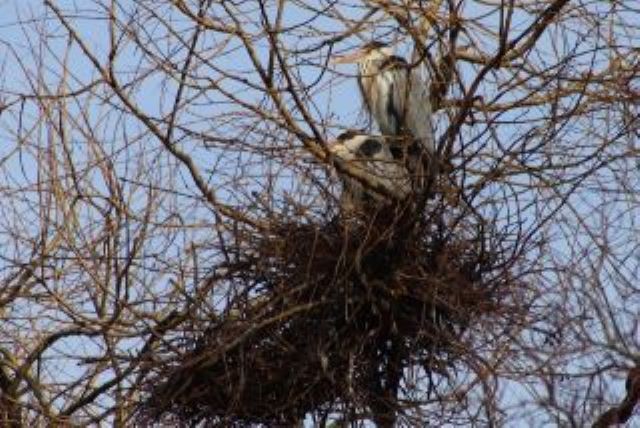
Heron's "untidy" platform nests
Buzzards construct large bulky nests in mature trees where they make a flattish platform and line it with finer twigs, grass, bracken and moss. Fresh bits of plants are used to decorate the nest and are regularly replaced. These nests can reach over a metre across. Waterfowl like grebes will make platforms of plant material that float on the water and are hidden behind vegetation.
The Scrape is the most basic type of nest consisting of a shallow hole on the ground. The nest can be lined with pieces of grass, small pebbles or feathers and usually there is some sort of rim to keep the eggs from falling out. Unfortunately, they are very prone to predators. Most therefore have eggs which are coloured to blend in with their surroundings which offers some sort of protection as it makes them very difficult to see. Most terns, shorebirds, many ducks and pheasants all have this type of nest. Peregrine falcons’ nests are normally on cliff edges although tall buildings in towns and cities will also be used. The female selects a nest site where she scrapes a shallow hollow in the loose soil, sand or gravel in which to lay her eggs. No nest materials are added. Peregrine falcons defend their nests against other peregrines, ravens and gulls.
Woodpeckers lay in Cavity nests. They prefer large trunks or branches of a diseased tree. When a suitable site is found they bore their nest holes straight on and then down into the tree. During this procedure wood chips will fall into the holes thus creating a soft bed for their young. Other examples of birds using holes are nuthatches, owls and wrens. Underground cavity nests are called burrows. These provide a relatively safe place to nest, from gulls for instance although rodents will be a problem. Burrow nesting birds include puffins, shearwaters, and kingfishers.
In most species it is only the female which builds nests, but some birds share in the building. Occasionally nest building is part of the male’s effort to attract a female. The male wren will find a cavity in a wall or tree to build the main structure of the nest. The female’s job is to help line it with feathers. It’s at this point that this tiny male bird shows aggression towards his competitors. He may destroy other wrens’ eggs or take over their nesting sites. He may even build other nests. He can have more than one wife. He provides little or no help for this second family and the brood will often die from starvation or are killed by intruding males. However, if the first female or her brood should die, he may start to raise his second family.
All birds use a range of materials to build their nests such as sticks, moss, lichen, mud and even spider silk. Materials such as string, pieces of clothing and other human made materials can also be used. Jackdaws who are cavity nesters very often adorn their nests with weird items from plastic garden ties and plant labels to bottle tops and packaging from take aways.
The time it takes a bird to build a nest (from a couple of days to over two weeks) depends on the bird and the environment. For instance, material availability, weather and even the birds experience will influence the time it takes to construct the nest. House martens sometimes have a hard time gathering up the mud they require to make their nests especially if the weather is very dry.
Birds like swallows which come back to their previous nest often only have to make a few adjustments. Some birds remove most of the old nest. This might be to get rid of parasites such as lice and mites that may remain in the old nest. A study of starlings has shown that they remove the old top layer of last year’s nest.
Parent birds generally don’t sleep in the nests. The only exception is when they are brooding eggs and young chicks and then the adult will stay in the nest to keep them warm. After 2 or 3 weeks most songbirds are ready to leave the nest. Other birds like raptors can stay for as long as 8 to 10 weeks and by that time the nest is very smelly.
If you want to help nesting birds why not leave out materials which they can use like sticks, moss, grass, cat, dog or rabbit hair and feathers. Invest in some well-made bird boxes. Different types can now be bought such as the half-opened nest box beloved by robins to wedge shaped boxes ideal for tree creepers. Avoid disturbing the birds by not trimming back bushes and trees. If the weather is cold keep on feeding them but make sure the feeders are placed close to your house which will deter birds like sparrow hawks from attacking. Remember to provide clean water as well. Cats are lovely but they are ruthless hunters so keep an eye on them when they are outside. The most critical time is from late February to early May when the bird has just laid eggs because if she is disturbed, she may leave the nest. She is less likely to do this when she has fledglings,
Of course, not all birds build nests. Everyone knows about the cuckoo. They lay their eggs in the nests of other birds such as dunnocks, meadow pipits and reed warblers and let them do all the hard work in raising their one large hungry chick! This behaviour is called brood parasitism.
BOOKS ; Nests by Susan Ogilvy,, Birds, Nests, and Eggs by Mel Boring
FOR FUN why not pretend to be a bird and build your own nest!
It could be very neat like a chaffinch or very large like an eagle’s!
Honeysuckle stems can easily be entwined to make the basic nest structure, or you could use playdough to form your nest.
Be creative and take photographs of your finished creation. You may find it’s not as easy to build as you had imagined!
FOR IDEAS; https/tinkergarten.com https/mothernatured.com
Childrens page written by Maureen Graham