


 English
In the mid 1500’s bats were often called by the rather enchanting name of flittermouse, no doubt because they resembled a mouse and had fluttery wings. Bats, however, are not related to rodents. Their closest relatives appear to be a group that includes whales, pumas and cows! They are also the only mammals capable of true flight.

Bats hanging upside down
Inhabiting earth for more than 50 million years there are globally about 1400 species ranging from the tiny Kitti’s hog-nosed bat which weighs about the same as two paper clips to the Giant golden crowned flying fox which has a wingspan of 1.7 metres. In Northern Ireland 8 species of bats can be found.
In the past bats have been divided into two suborders the megabats or fruit eating bats and the microbats which are mainly nocturnal insectivores. Microbats find their prey by echolocation, sending out loud squeaks so high pitched that humans can’t hear them. The bats listen to the echoes of these squeaks which bounce off objects near to them and from this they can identify if it is potential food such as a moth or if it is an obstacle such as a human in their path This is why it would be very unusual for a bat to collide with you or get entangled in your hair!
Microbats can be found throughout the world apart from very cold regions. They are insectivores and hunt at dusk or night. Due to their small size and their high metabolic rate they must consume large amounts of insects to survive. They can travel many miles up to 24 miles per night in search of food. Moths, beetles, flies, grasshoppers and bees are all good ‘bat food’. Some bats that hunt insects in flight will catch them in their mouths and either eat them in the air or scoop them up using their tail and eat them on a perch. Horseshoe bats are an example of this. A few microbats such as the African yellow winged bats hunt insects during the day.
Megabats or fruit bats are diurnal They live in Africa, Asia, Australia and islands in the Indian Ocean. With a few exceptions they do not use echolocation relying on their senses of smell and sight to locate food and to navigate. They have a rather dog like face and use their large eyes to find food such as bananas and melons. Some megabats sip nectar. The Tube lipped nectar bat has the longest tongue of any mammal! They will pull fruit off trees and fly back to their roost. These nectar eating bats all have long muzzles and tongues, and therefore can reach deep into the long cups of flowers. When the tongue retracts it coils up inside the rib cage. About 500 flowering plants rely on bat pollination.
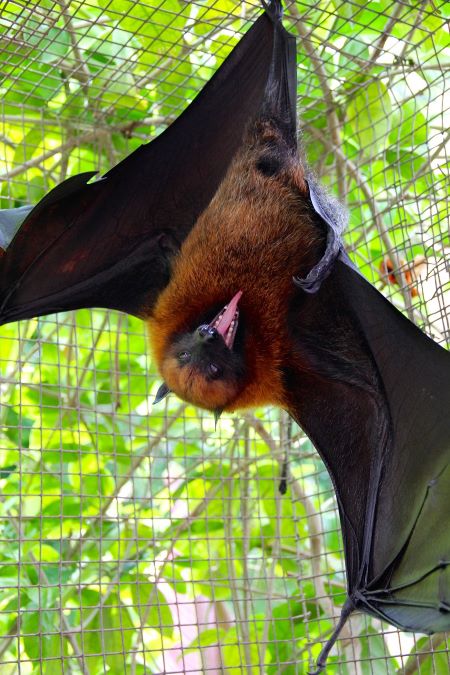
Flying dog bat (long muzzle and tongue for sipping nectar)
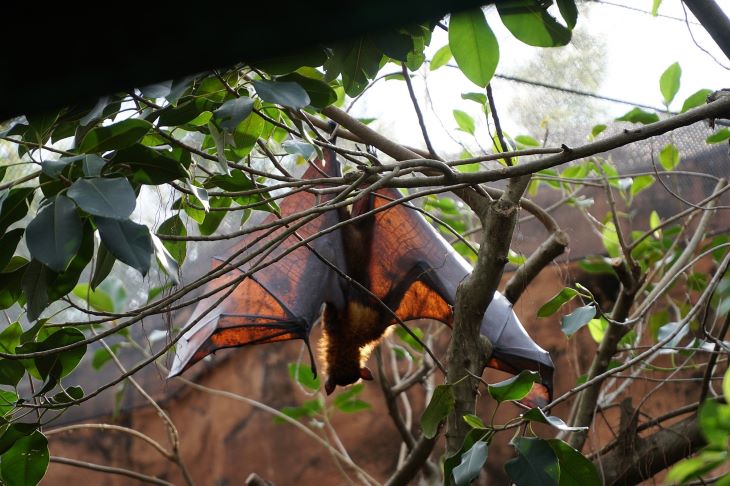
Rodrigues Fruit Bat
Some bats in the tropics prey on vertebrates such as fish, frogs, lizards, birds and mammals. The Fringe lipped bat is a skilled frog catcher It will track down frogs by listening to their mating calls and then pluck them from the water. Some scientists believe that this bat can even determine the species of frogs by their calls and thus avoid the toxic ones. The Greater Bulldog bat hunts fish by using echolocation to detect ripples in the water surface. The Ghost bat from Australia feeds on other bats and vertebrates which they detect using not only echolocation but also sight and hearing.
Perhaps the most famous bat is the vampire bat. These much-maligned bats live in Central and South America in caves, tree hollows and abandoned buildings. They are small and weigh less than 2 ounces and unlike other bats they can walk, run and jump. With heat senses in their noses, they can locate a good place on an animal’s body to feed. They also have a special thumb and strong hindlegs which helps them take off after feeding although sometimes they are so gorged with blood that they crawl to a quiet place to digest their meal! Despite all the horror stories they would much prefer to take blood from cows, pigs, horses and even chickens rather than us humans. They are remarkable in so many ways. For instance, they can recognise breathing patterns of an animal which they have taken blood from and will often return to feed from that same animal night after night. They have sharp incisor teeth which makes a small cut in the flesh of their victim, and they then lap up blood with their tongues. They do not suck blood! Their saliva contains an anticoagulant that causes the blood to flow without clotting. They can feed on the animal for as long as 30 minutes without the animal even noticing. If they have not eaten for a couple of days, they will not survive. However they are a very sociable species and others in the roost will regurgitate their food to help their companions. Although their bite is not painful, they can transmit the rabies virus. The loss to the cattle industry, for instance, due to rabies in Central America can amount to many millions of dollars every year. However, it has been shown that a high percentage of healthy vampire bats do not carry rabies.
All bats live in different habitats ranging from mountains to deserts. All require suitable roosts which can be in tree crevices, lofts in houses and in caves. Some like the Mouse eared bats are solitary while others like the Mexican free tailed bats live in large colonies of 20 million. Large groups like this lessens the risk to an individual of predation.
Once it begins to get cold and food becomes scarce bats go into hibernation. In the animal’s body changes occur, involving a reduction in the heart and respiratory rate and their temperature dropping to near freezing. Some bats hibernate on their own such as the Natterer’s bat or in colonies like the Pipistrelle bat. Hibernation sites or hibernaculas must be in cool quiet places as it can be dangerous for a bat to be disturbed when so heavily asleep.
Some bats avoid hibernating by migrating to warmer climates where food is still plentiful. The Hoary bat migrates in winter from North America to the warmer climate of Central America. Not all bats hibernate or migrate. In Florida for example bats will go into what is called a torpor state. This means that their body temperature and heart rate will lower slightly but they will not go into full hibernation and when conditions are right, they will become active. Megabats do not hibernate. Because of the need to eat so frequently vampire bats also do not hibernate. The rare Bonneted bat of America remains active in Florida all year round and never hibernates.
Bats are among the most vocal of mammals and produces calls which can tell other bats were there are thus avoiding head on collisions! These calls can travel long distances. Calls are also used to attract mates. The Mexican free tailed bat sings like a bird to attract females. The Greater sac winged male bats from Central and South America secrete a mixture of saliva and urine which they store in their wing sacs. During displays for females the male will hover in front of the female and fan her with this scent The Hammerhead bat also displays to attract females. They have a lek courtship system where up to 150 males gather twice a year to impress females. The bats gather at night along a stream where males line up on tree branches. Males attract females with loud vocalizations and wing flapping. Females will fly amongst them until when they finally choose one, they will come and sit on the branch alongside the lucky male. Rather like 1960 dances!
Bat displays are unusual. Most males will mate with multiple females. Some species have delayed fertilization or delayed implantation and will wait until external conditions become favourable before giving birth. Pregnancy can vary from 2 to 7 months. Microbats living in temperate regions tend to have shorter pregnancies. Vampire bats have very long pregnancies. With most bats a single young or pup is born although the Northern yellow bat, the Eastern red bat and the Hoary bat can give birth to litters of four or five. Female bats give birth head up or in a horizontal position. The pups are born pink, naked and blind. They have big hind limbs which help in making sure they stay clinging to their mother. Mostly it is the females who raise the young and they are very good mothers. Pups are left in the colony when the mother goes off hunting. The colonies of some bats can be so large that echolocation and smell play a vital part in the mother finding her pup after a hunting trip. In these maternity colonies bats may help each other in birthing and even suckling other mother’s babies. After 80 days the pups are weaned. It has been estimated that only 30 -40% of young bats will survive.
A bat’s lifespan can be up to 30 years. Cave living bats may live longer because of decreased predation in caves. All bats will carry a certain number of fleas, mites and other specific bat bugs which can be detrimental to their health. Interestingly they do not carry lice. Bats are predated on by owls, hawks, snakes, cats and even other bats. Humans eat them and will kill them to protect fruit crops and because of diseases that they may carry. Unfortunately, millions of bats are now dying from white nose syndrome, a fungus which infects bats especially during hibernation. Climate changes and habitat loss such as the destruction of trees and hedgerows are leading threats to bats as are building and developments. The use of pesticides and insecticides have certainly added to their decline. Collisions with wind turbines are another danger.
In the West bats have been associated with witchcraft, evil and disease. In China it is the opposite. Bats are associated with, long life, happiness, joy and good fortune. It would be nice if more people could hold these positive views and realize their importance in the world. It has been estimated that they save U.S agriculture over 3 billion dollars annually by eating pests and of course they eat large amounts of insects like mosquitos which are harmful. They pollinate plants like bananas, avocados and mangoes. They disperse seeds and their bat dung or guano is very rich in nitrogen and is a great fertilizer. Scientists are studying the anticoagulant found in the saliva of vampire bats to determine its possibilities in the prevention of strokes.
40% of all bat species are threatened or at risk of imminent extinction The Sheath tailed bats of the Seychelles are in great danger as are the Livingstone’s fruit bats. Although zoos often get a bad press the Jersey zoo has a breeding colony of these fruit bats and in 2022 sixteen pups were born. Sadly In 2009 the Christmas Island pipistrelle was declared extinct although it had once been common on Christmas Island.
It’s still not too late to save bats although our negative and ignorant attitudes towards them must change. They are not creepy, scary, spooky or stupid!
NEXT MONTH will be Part 2 of bats when the 8 species which live in Northern Ireland will be explored
Meanwhile gardens, woodland, farmland and rivers are all good places to look out for bats so get ‘batting’!
Flittermouse Part 1 written by Maureen Graham