


 English
Seeing dragonflies along with their close relatives the damselflies flitting across a pond or lake is a sure sign that the summer has begun!
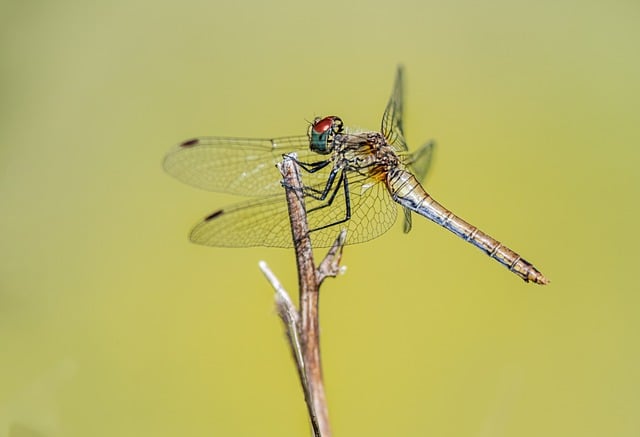
Four-spotted Chaser dragonfly
Dragonflies and damselflies have lived on this earth for 325 million years. In prehistoric times they were the largest flying insects with some having wingspans of more than 2 feet. They inhabit every continent apart from Antarctica, At the present time it is thought that there are 7,000 species of true dragonflies existing in the world.
In Ireland there are 14 resident dragonfly species, 11 resident damselflies and 5 visiting species. Dragonflies are easy to identify from other insects by having large bodies, small antenna and four long horizontal wings. They can reach speeds of up to 35 miles an hour. They have huge compound eyes so large that they nearly touch each other and each of these eyes have about 28000 single eyes. They rely on their eyesight more than touch or smell which is why their eyes are so complex and their antenna so tiny.
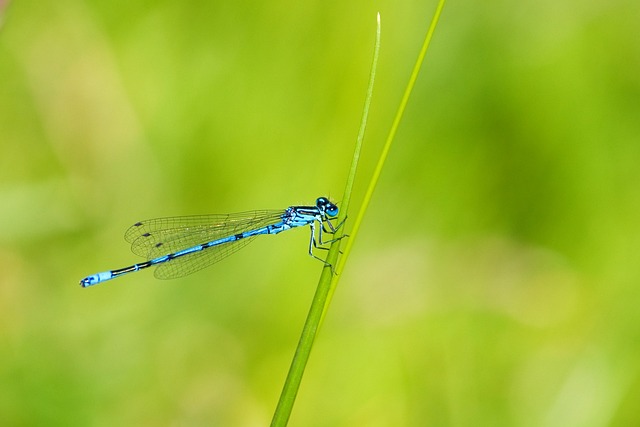
Azure Damselfly
Dragonflies and damselflies are often confused with each other as they appear so similar. Dragonflies can be distinguished from damselflies as they are larger (about 85mm long), and their wings are held open when resting. Damselflies on the other hand are smaller, (about 50mm), slimmer, eyes which are set far apart giving them a hammer-head appearance, and with wings which are held close to their bodies when resting. They are also weaker flyers, but both species demonstrate amazing acrobatic skills in the sky being able to hover, dive, swerve, change directions and even fly backwards! The males especially often have dazzling iridescent body colours.
Many dragonflies and damselflies have marvellous names such as the four spotted chaser, the downy hawker (both dragonflies) the beautiful demoiselle and the crescent bluet (both damselflies) The latter is also called the Irish damselfly. It is found in Asia, Northern Europe and Ireland but not in Britain. It is rather uncommon but can be seen around sheltered lakes, large pools and boglands in Counties Fermanagh, Tyrone and Armagh. Males of the Irish damselfly have bright green undersides especially on the head and thorax. Females are dull green with black markings
Both insects have a life cycle of 3 distinct stages. Around Midsummer females hover over fresh water to lay very tiny eggs. They are laid either singly on the inside of stems and leaves or in clusters on wet mud. They hatch within 1 to 5 weeks depending on the surrounding temperature. Any eggs laid in October may not hatch until the following spring due to the cold weather.
When they hatch, they are called nymphs, and they stay in the water for up to three years although some damselflies can take only a few months while in the case of the golden ringed dragonfly it can be 5 years before they eventually become an adult.
The nymphs of dragonflies are larger and squatter than damselflies. Damselfly nymphs sometimes swim around like small fish. Dragonfly nymphs do not swim but on occasions they may expel water from their rectum, and this will jet propel them across the water! They are fearsome predators and eat insects, small fish, tadpoles and even other nymphs. They are specially equipped with a lower jaw that can reach out and open sideways thus snatching prey into their mouths. At various stages in the nymph’s life, they must moult their skin to grow. This process is called ecdysis. They become very vulnerable to attack from predators at this time. They undergo between 6 and 18 molts before emerging as a fully formed adult, a very long process that takes about 12 hours. The nymph castings they leave behind are called exuviae.
Newly emerged adults called tenerals have shiny wings but lack the colour of mature adults. They like to feed and roost away from water. Dragonflies especially disperse more widely than damselflies and hunt as single individuals in sheltered woodland. They feed on smaller insects such as butterflies, bees, midges, flies and smaller dragonflies and damselflies. Their legs slant upwards forming a type of basket which enables them to scoop up prey in flight. In poor weather they can’t fly and will rest in vegetation. Predators are birds like the kingfisher, spiders, frogs, newts and even carnivorous bog plants. On reaching maturity they go back to the pools. The males tend to be found closer to water than the drab females. Dragonfly males are very territorial and may even follow the female after mating to guard her from other males. Females have multiple partners, but it is only her last partner who will fertilize her eggs. Females will sometime play ‘dead’ to prevent anymore unwelcome suitors!
Most Irish species live for 15 to 22 weeks but a large number die within a few days. During summer the two nymph species can be seen on stems of rushes and reeds as they transform into adults. Garden ponds, rivers. lakes and bog land are all good places to spot these super insects.
Dragonflies and damselflies are important as predators of mosquitoes and flies and as prey to birds and fishes. Both are threatened by loss or decline of their habitat. As so many wetlands have been polluted by intensive agriculture or drained for development, the habitats they depend on have shrunk. The Irish damselfly is very sensitive to nutrient status of lakes especially if it becomes too rich. Northern Ireland holds the entire UK population of this species so it’s important they are protected. As they are on the red list any sightings should be reported to CEDaR; Tel. 02890395256. Scientists have discovered that dragonflies and damselflies are also important as reliable bioindicators of water quality as they require clean well oxygenated water to survive.
Finally, both species have many myths associated with them. Dragonflies have been associated with the devil and have been given horrible nicknames like ‘water witch’ or ‘hobgoblin fly.’ However, they are far from evil especially if we consider the number of mosquitoes they eat. A far better name is ‘mosquito hawk.’ Sometimes they are called ‘horse stinger’ This suggests they sting which they physically can’t do, nor do they attack people. Only if severely provoked will they bite and a bite in most cases will not even break human skin. They may fly around horses, but this is only to improve their chances of feeding on the insects which are attracted and no doubt annoying these animals. Damselflies can be referred to as’ Devils Darning Needles.’ This stems from the myth that if a person falls asleep by a stream damselfles will use their long thin bodies to sew the person’s eyelids shut. Naturally this is untrue!
A dragonfly represents spiritual growth. It is the spiritual animal for June and is said to bring joy into our lives. Just by watching them they certainly do!
BOOKS ; (can be bought from Amazon)
Dragonflies and damselflies of Ireland.
Are you a dragonfly (by Judy Allen)
Fun Facts about Dragonflies
Oh, My It’s a Dragonfly
HOW TO MAKE A TWIGGY DRAGONFLY
ADULT HELP NEEDED
You will need.
A twig
Cardboard (cereal box for example)
Scraps of fabric and ribbon
Colourful paint (blues and greens for example)
Buttons
1. Find a nice straight stick and paint it. Leave to dry. This is the insect’s body.
OR You could wind colourful wool around the stick if you don’t want to use paint
2 . To make the wings draw 2 large wings and 2 smaller ones onto a piece of cardboard. Cut them out and either paint them or cover them with glue and stick on scraps of paper
or fabric. Ask an ADULT to glue these wings on to the stick using a glue gun or very strong glue (The smaller wings go below the larger ones)
OR You could make it very easy by simply tying on to the stick 2 bows from fabric (tulle or net are good) to represent the wings.
3. For their large eyes you can use small pompoms, beads, shells, marbles, playdough or buy a packet of ‘sticky eyes’.
4.Make more than one dragonfly and have fun placing them around your garden! Just stick them into the ground and see how they flutter!
Dragonflies and Damselflies written by Maureen Graham