


 English
For the past month at roughly three o’clock a flock of delightful long-tailed tits descend on to my bird hangers to feast on suet treats. They stay for about fifteen minutes and then as quick as they have come, they have gone.
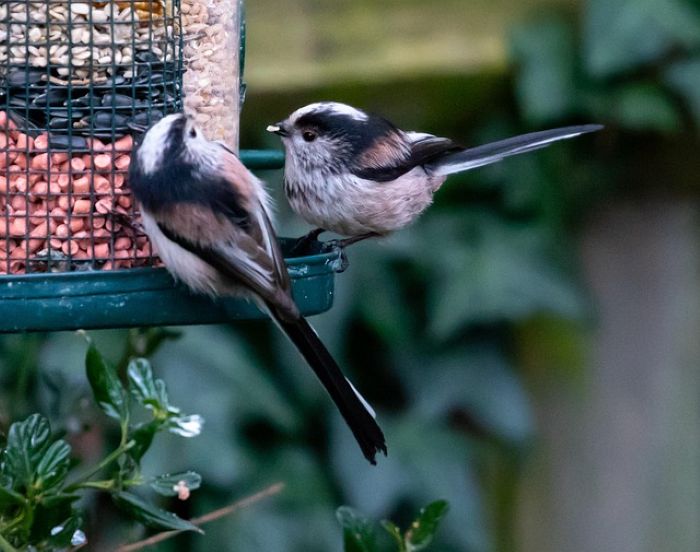
These small attractive birds weigh about the same as a 10 pence piece and possess a tail more than half their length. They are very striking with black, white and pink plumage. The first clue that there are about are from their high-pitched calls. They also never travel alone and can often be seen with other members of the tit family. A flock of long tail tits which can be more than 50 is called a party. The usual number consists of ten birds, comprising a breeding pair, their offspring and one or two non-breeding adults that are related to the male of the pair. This flocking instinct is very important to such a small bird as many eyes can detect predators and numerous voices raised in alarm will alert all the birds to danger.
They have a weak flight described as ‘whirring’ and’ bouncy’ but despite this they can travel as much as 7 kilometres in one day. Found mainly in woodlands. hedgerows and gardens they do not live on moors and mountains. They feed almost entirely on insects, spiders, caterpillars and moth and butterfly eggs. it has only been in relatively recent years that long tailed tits have become visitors to garden feeders eating suet balls and blocks, peanuts and to a lesser extent seeds.
Mid-February is the start of pair formation. In March and April winter flocks will disband and females will disperse to join other flocks. Males establish their own territories and when unpaired females arrive the males perform jerky display flights rising five or six metres into the air before diving into the vegetation all the while opening and closing their tails. Sounds like a lot of work! These displays may be performed by as many as four males until a female chooses one lucky suitor. Once they have paired, they begin nest building. This may take as long as a month to complete as the nest is very intricate. It is a domed oval structure with a round entrance hole high in one side and is made of mosses and lichen held together with cobwebs. They also use silk from bees and wasps cocoons as it provides both strength and elasticity for the fragile nests. Nests are lined with tiny feathers and are usually located high in the trees. Once completed the birds will leave their winter flock and occupy their new nest.
The female lays between 7 to 12 smooth white eggs with tiny reddish speckles. The incubation period is about 15 days. On hatching the young are naked and are brooded by the female. The male as well as other helpers feed them, and this improves the breeding success. By 17 days the chicks fledge although they are still fed by the parents. A hierarchy eventually becomes established among the young birds.
The status of the long-tailed tit remains stable with an estimated population of around 250,000 plus breeding pairs. In the UK the population can suffer in severe winters and losses of up to 80 % have been recorded. Nests are often destroyed by jays and crows and of course adults suffer from predation by birds such as sparrowhawks. Another threat is a mismatch between when caterpillars are available to eat and when the baby birds are hatching. Little food means chick fatalities. The loss of habitat of course is always a problem to all wildlife but overall, it appears that the long-tailed tit will continue to delight us for many years to come.
BOOKS
Wildlife Watchers : Long-Tailed Tit by Ruth Owen
TO MAKE CUTE BIRDS.
NEED :-
Toilet Roll
Glue
Feathers-----buy or pick up feathers on country walks
Felt tip pens and paint
Material (optional)
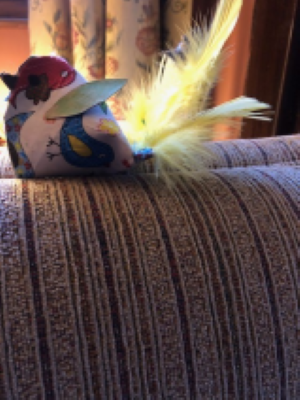
1.Glue feathers inside the end of a toilet roll tube.
2.Press these feathered ends together bend upwards and glue.
3. At the other end press ends together in opposite way and using a felt tip pen make a curve with scissors
4. Use one of the cardboard scraps to make a beak by drawing a diamond shape , Cut this out and fold in two. You have now got a little beak!
5. Paint the bird. If it is a Long-tailed tit paint it black, white and pink. Or you can make a very colourful bird by gluing scraps of material on to it.
6. Make wings out of cardboard scraps by drawing a leaf shape . Cut this out and paint or glue material on to it and then glue on to the sides of the bird.
7. Using a black felt tip pen draw and colour in eyes. You now have a bird! Make more than one and hang them up using thread or set them on a shelf or be very creative and make a nest from moss and twigs and set ‘Birdie’ in it
Long-tail Tit Article by Maureen Graham