


 English
When I was a child, I visited a neighbour’s house so often that if she was busy, she would send me into the nearby corn field to look for harvest mice. I never saw any as they are not found in Northern Ireland, but it kept me busy for half an hour and no doubt gave her some peace. She was confusing the harvest mouse with a wood mouse or as it can be called the long-tailed field mouse. This mouse is larger than the harvest mouse with a brownish back, a white, grey belly and a non-prehensile tail. The poor wood mouse can also be mistaken for a house mouse. The two are different species and do not interbreed. The main differences are wood mice have larger eyes and ears, brown fur and live mostly outdoors in woods or gardens. During autumn and winter they will come into buildings for shelter and food. House mice are not so cute They are larger with small features, grey, brown in colour and are usually found in buildings. They also have a stronger muskier smell!
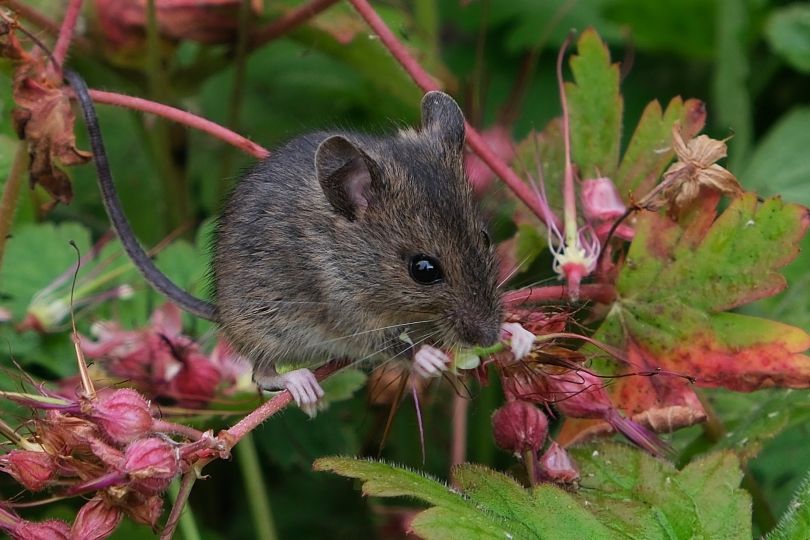
Wood mouse at Global Medicine Garden Belfast Botanic Gardens--photo by Kevin McKernan
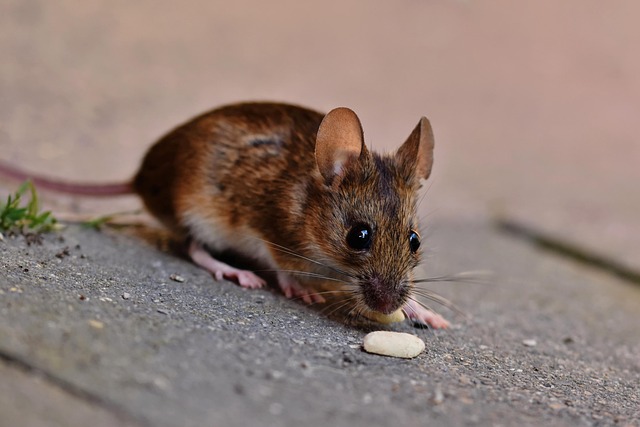
House mouse --it is bigger than a wood mouse
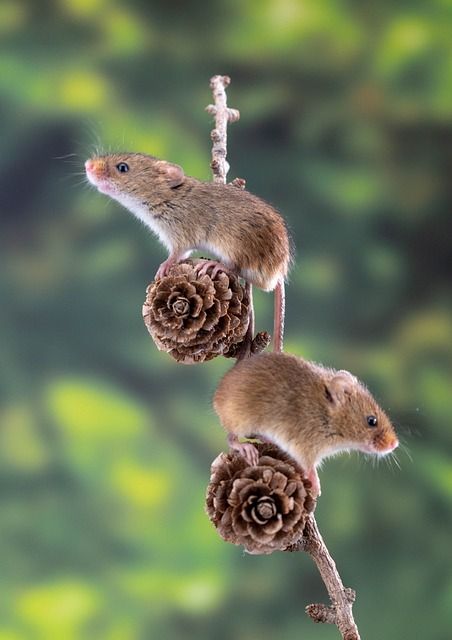
Harvest mice--they are even smaller than wood mice
Native to Europe and Northwest Africa the nocturnal wood mouse is mainly a solitary animal. In winter especially if it is very cold, they may share their nests with each other to provide warmth or may even go into a torpid state if the weather becomes really bad. They are omnivores which means they will eat seeds, fruits, flower buds and fungi as well as insects, worms, caterpillars and centipedes. Their droppings are black, tiny and tapered at both ends.
The main breeding season is from February to October, but it may be longer if the weather is mild and food is abundant. The males are quite aggressive during the breeding season driven by competition for territory and females. The nests are constructed from leaves, moss and grasses and can be found underground or in shrubbery, trees and even old birds’ nests. Females do all the caring of the young and can have multiple litters per year with between 4 to 8 babies or pups (as they are called) per litter. After 26 days the pink hairless pups are born and by 4 weeks, they are independent of their mother and by 8 weeks they are sexually mature! Their lifespan is short, however. They can live in captivity for a couple of years, longer if well looked after but in the wild they would be lucky to live for a year. This is because they are an important food source for larger mammals like foxes and stoats as well as birds of prey. Disease and starvation also play a part in controlling their numbers.
Wood mice although very cute (I think !) do carry diseases such as Weil’s disease, salmonella and may harbour fleas, mites, ticks and tapeworms all of which can be transmitted to humans so it’s important not to have them in the house. Let’s not forget that they may also chew through electrical wires, damage wood and insulation. To discourage them from entering houses, plants nearby should be trimmed back , the outside kept tidy with no food left lying around. Inside a house these rodents can be deterred by keeping all foods in chew proof containers, sealing trash bins, using steel wool to block up any entrance holes and by buying door sweeps which will close gaps on the bottom of doors. These mice can squeeze through a gap as small as 6—10mm using their whiskers to determine the size of the opening and they then flatten their bodies like a pancake. They can do this because they have a very flexible skeleton. Strong smells like peppermint, cloves, vinegar and ammonia from cat urine are deterrents and they also dislike loud noises and bright lights. Buying live traps should only be used as a last resort. They may not be as cruel as the lethal snap traps, but they can still cause the animal a lot of stress and potential injuries. If used they should be checked hourly so that the mouse is not in the trap for a long period. Releasing a mouse into another environment almost always will kill them as they will find it difficult in a strange area to look for food, water and shelter and will be more prone to predation and disease. They should be released at dusk and if very cold as in winter an empty outbuilding with a little food is their best chance of survival. Some authorities recommend releasing them outside close to where they came from while others are of the opinion that two miles away and providing food for a week is a safer option for them not returning to your house. Poisons and snap traps should never be used. Both are dangerous to humans, pets, wild birds and other wild animals.
Wood mice are fascinating and amusing little creatures to watch, they are agile climbers, can leap high when disturbed and like squirrels they have a habit of hoarding nuts and berries in autumn to eat when food becomes scarcer. They play a crucial role in helping to spread seeds and it has been discovered that they will leave a trail mark by picking up leaves and twigs so that they can find their way back home in the dark.How Hansel and Gretta is that!
Wood mouse article written by Maureen Graham Honorary Secretary