


 English
Cookstown Wildlife Trust visited Mallon Farm on the Pomeroy Road on Saturday 20th July at the invitation of the owners Helen Keys and Charlie Mallon. The weather forecast was poor, and we came close to cancelling. However, we had a good turnout of 23 members and guests and 4 young people also attended.
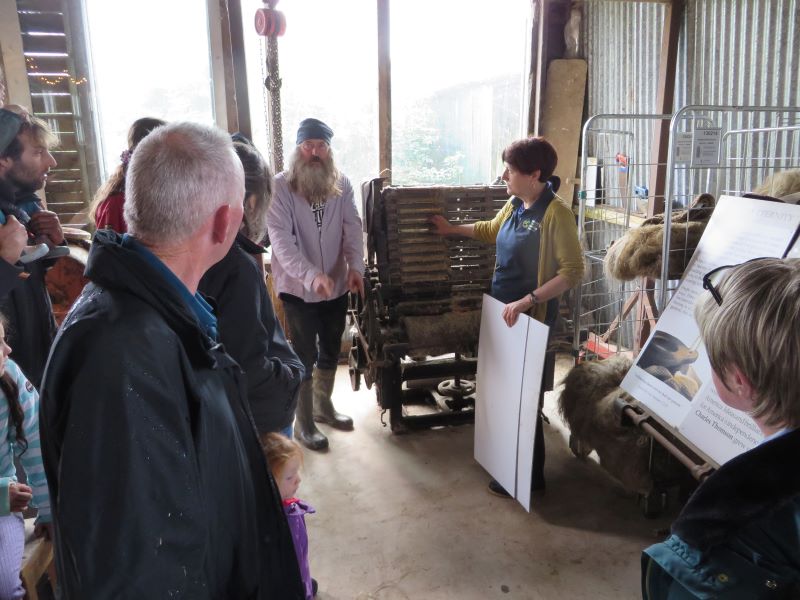
Charlie and Helen welcomed us to Mallon Farm
This is the Mallon Family farm which Charlie had inherited. Charlie is a bronze sculptor and was seeking linen cloth to wrap his sculptures but had difficulty accessing linen despite Ulster in the past having been the centre of an extensive flax growing and linen industry. Charlie and Helen then had the idea of trying to grow and process their own flax. Starting 7 years ago they now grow a field of flax every year, maximum of 4 acres per year. Flax grows best in heavy soil and must be grown in rotation as it draws a lot of nutrients from the soil which therefore needs time to recover. The ground is prepared and chain harrowed one month before sowing to knock the weeds back.
They sow flax with a traditional “seed fiddle” with the operator pacing up and down the field using marker posts as a guide. To ensure even spread of seed they then sow the field again this time pacing across the field. Best results are obtained by sowing densely at 3 bushels per acre (a bushel is a dry measure of volume and equals 8 gallons)
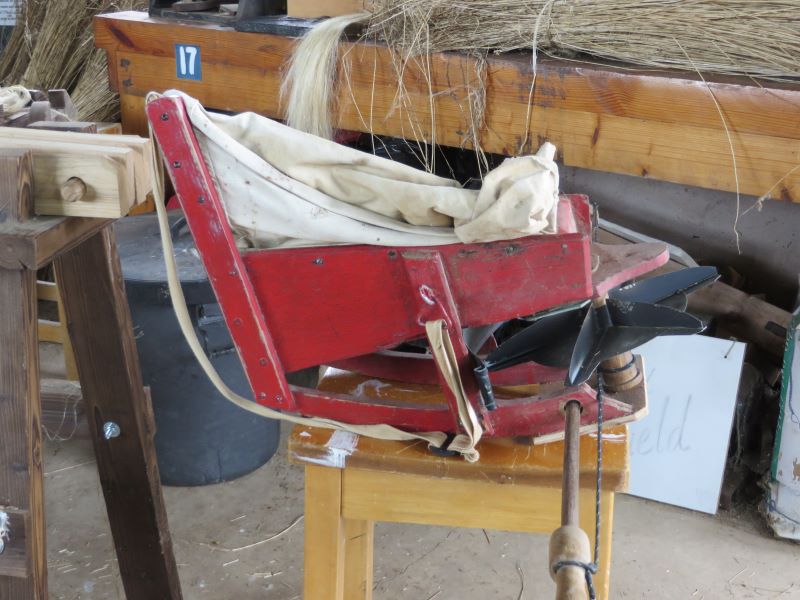
Seed Fiddle--used to sow flax seed
A short branchy variety is the best to grow if planning to harvest flax purely for seed. A long variety is best for fibre but not too tall otherwise the flax falls over before harvesting. If flax “lodges” for too long a time before harvesting it begins to rett in the field. Also very tall flax will not fit their scutching machine.
Unfortunately the flax crop at Mallon Farm has failed this year and they had no field of nice blue flowers to show us. Apparently there have been bad flax harvests all over Europe recently—possibly due to the wet colder weather this spring and summer.
Flax grows for 100 days. When yellow about 2/3 way up the stalk it is deemed ready for harvesting, usually in early August at which stage it is pulled by hand. (Varieties grown for seed are allowed to grow for longer).
Fred Faulkner who was with us, described how in times past a “flax boon” of 10-12 men would travel from farm to farm, pulling flax by hand. They were paid by the number of beets pulled. A beet was a bundle of about 23 inches circumference held together with bands of rushes or “sprit” tied with a non-slip reef knot. The flax was then “retted” by submerging in static water in the “lint hole” for 9-14 days. The duration in the lint hole depended on the overnight temperatures and if it was wet weather. The flax is checked daily to decide when to remove it from the water and spread it out to dry—a very smelly process. The Mallon rett their flax in old cheese vats. Flax water is a very toxic pollutant and lethal to fish and other wildlife and must not be allowed into water courses.
After retting the dried flax is then in turn put through the processes of scutching, hackling, spinning, weaving and finally beetling.
In the past most scutching was done by hand whereby the “scutcher” held a bundle of flax close to rapidly rotating wooden blades so that the flax was beaten repeatedly to remove the outer woody plant material leaving the silky inner fibre behind. A dangerous process with very few scutchers retaining a full set of fingers until retirement!
Charlie located and restored a 1940’s mechanical scutching machine. This machine had originally been manufactured in Mackie’s Engineering Foundry on Springfield Road Belfast and had worked for years at Hardy’s Scutch Mill near Coagh. There were relatively few of these mechanical scutch mills in Ulster. They are much safer than the traditional rotating scutch blades having an ingenious method of first crimping the flax stalks with rollers before beating it repeatedly to remove the woody outer plant material leaving the inner flax fibre. The scutching is done in the innards of the machine without the operator having to get close to any moving parts, therefore without having to risk losing any limbs or digits! Charlie uses an electric motor to power their scutching machine.
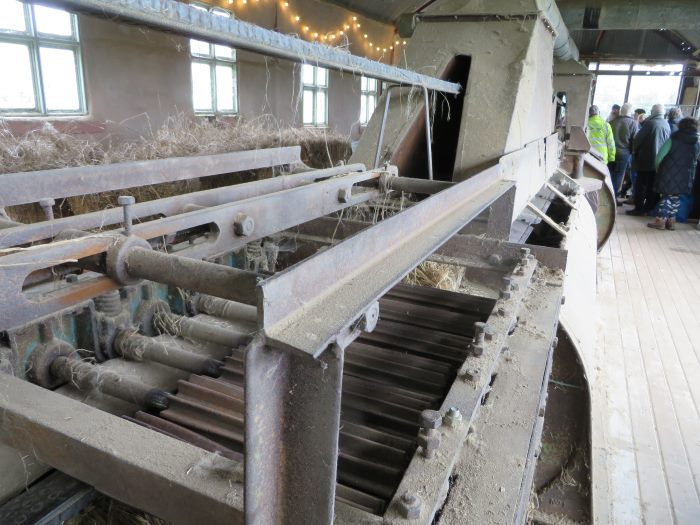
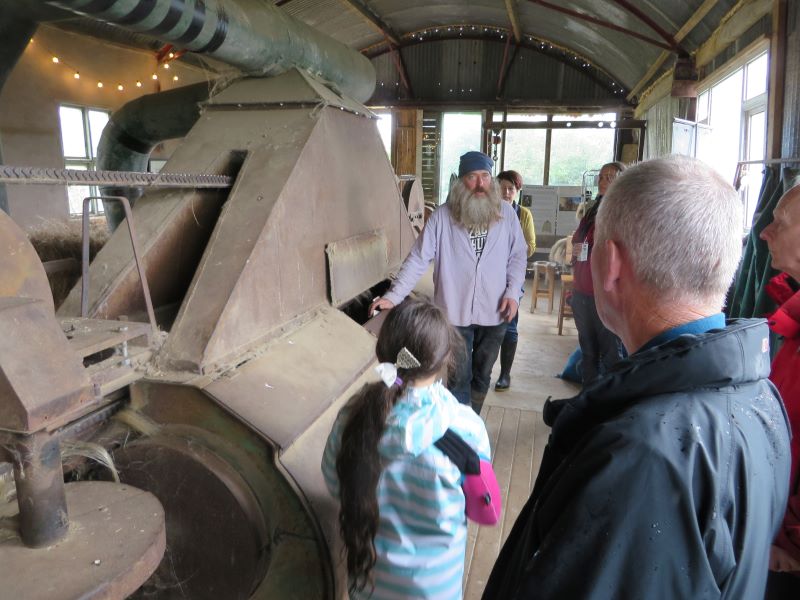
The crimping rollers The scutching machine
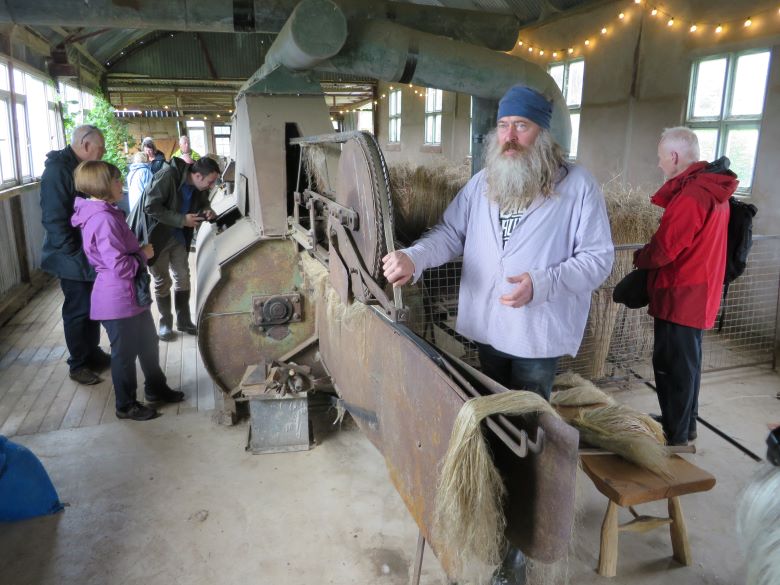
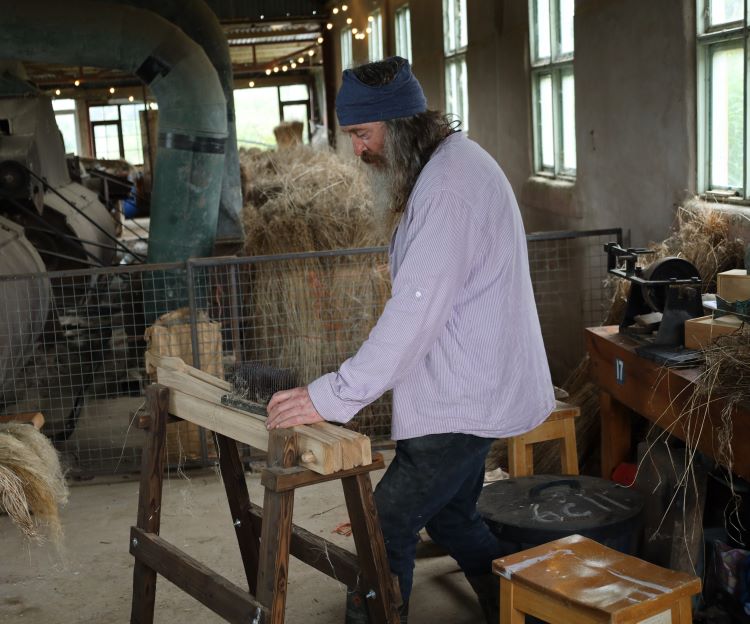
Charlie demonstrates the scutching machine and then hackling.
After scutching the flax is then pulled through spiky steel teeth to split and straighten the flax fibres—a process called hackling.
Next comes spinning. There are no flax spinning machines left in UK or Ireland. Only hand spinning left—Mallon Farm supply flax to hand spinning classes. Paper makers buy flax. Lamp shades are made. A raincoat has been made from their flax. The fashion industry buys flax from Mallons to make fake fur.
Recently car manufacturers have been looking around for an alternative to carbon fibre and fibreglass. Mixing resin with spun flax creates a material with the appropriate properties. The film industry buy flax from Mallons for wigs and beards.
Helen and Charlie also save and sell flax seeds. They are used as a health food and to make linseed oil used in polish.
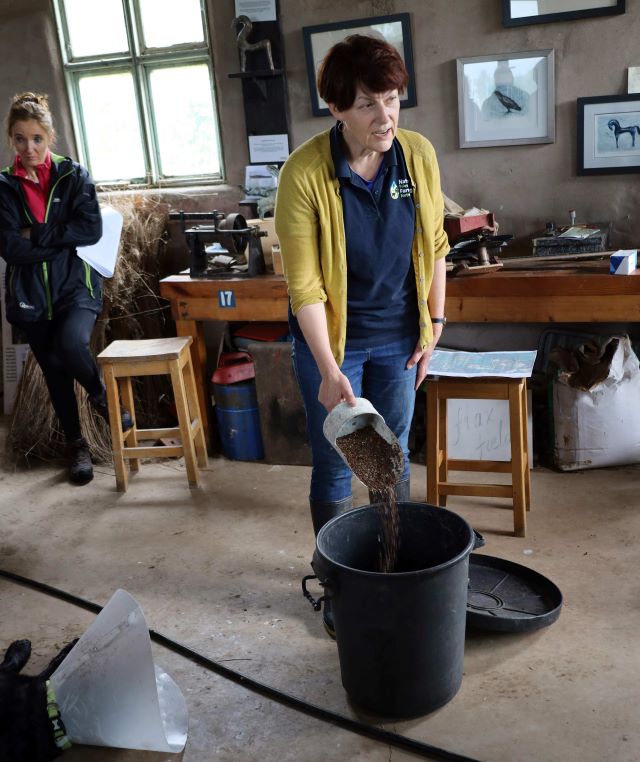
Helen shows us some flax seed they have saved.
It is Charlie and Helen’s hope that other local farmers will start growing flax in future. They have the scutching machinery to help process this.
During Helen and Charlie’s talk we were delighted to see a family of swallows feeding their chicks perched on the girders of the shed.
Helen and Charlie explained how they farm for wildlife and are part of the Nature Friendly Farming Network. Their old meadow has not been ploughed in living memory. They have not used fertiliser or weedkillers for the last 20 years. Helen took us across the meadow. Lots of rushes, bird’s-foot-trefoil, meadowsweet, red valerian and meadow vetchling seen. Hedgerows are tall and wide with mature trees. A snipe has been captured on trail camera.
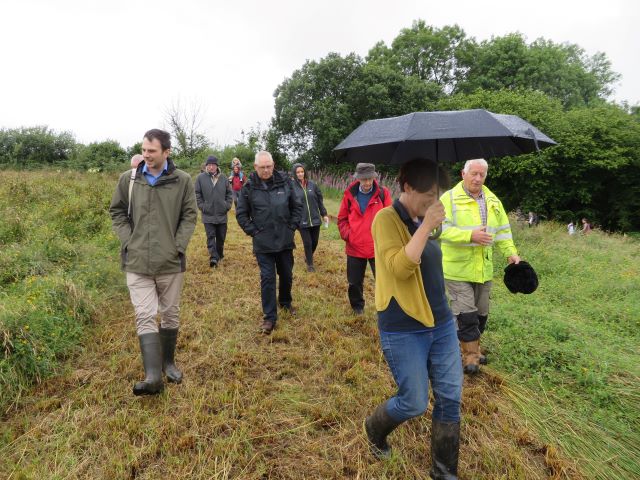
Helen led us through the meadow
A neighbour grazes his beef cattle there in the late summer/autumn—cattle can stay on this meadow longer into the winter without poaching the ground.
We visited a copse of trees off the meadow with several badger setts. As usual the badgers had put out their bedding to dry.
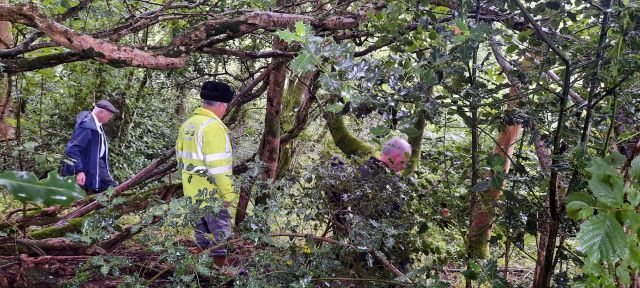
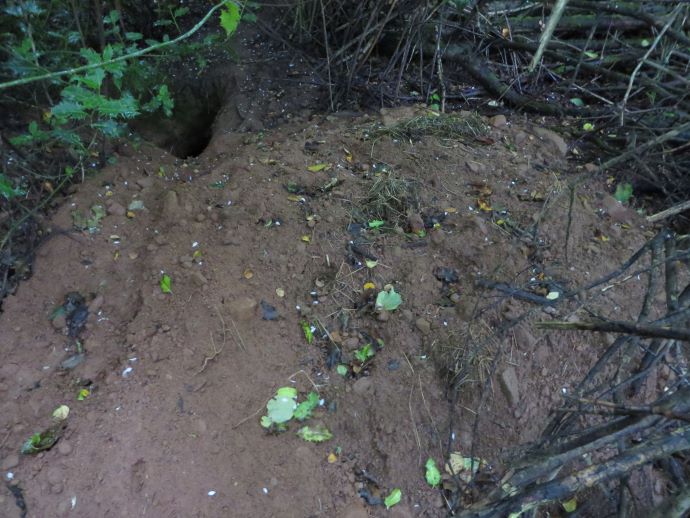
In the trees looking for badger setts. A badger sett
A light drizzle came on when we were going round the field but despite this three Meadow Brown butterflies were flying.
Helen told us that the stream at the bottom of the field has otters, which again have been captured on trail cameras.
Charlie and Helen have an orchard and bee hives in 3-4 locations, selling honey and fruit. They also sell other foods foraged from the farm including blackberries, hazelnuts and gorse flowers for herbal teas.
Mallon Farm also run a “vegbox collective” collecting vegetables grown on neighbouring farms putting them into weekly boxes for customers who pick their boxes up from local collection points.
At the end of our walk, we were entertained to tea and buns. The Chairperson thanked Charlie and Helen for inviting us to Mallon Farm and for a most interesting morning and also thanked Fred Faulkner for sharing his experience of working with flax in the past.
Trip Report by Ernie Hunter