


 English
Our chairman, Ernie Hunter welcomed all members including several new members to our meeting. He reminded everyone of the fungi walk to be led by Jackie Arrell on Saturday at Derrynoid. Mike McGrath introduced our speaker for the evening, Simon Gray, Head of Peatland Recovery with Ulster Wildlife. This group now have three offices in Northern Ireland, Belfast, Enniskillen and An Creggan.
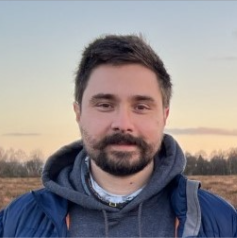
Simon Gray Ulster Wildlife who spoke to us on Peatland Wildlife
Simon explained that peat is basically waterlogged soil and is an accumulation of vegetation which is prevented from fully decomposing. 18% of Northern Ireland is covered in peatlands. Peatlands are made up of blanket bogs and heathlands which are found on uplands such as in the Belfast Hills and the Sperrin Mountains, raised bogs which can be found in the Bann Valley and Lough Neagh and fens which are like reed beds, their water coming from groundwater and not from precipitation like the others mentioned. Fens can for be found in Lecale in Co. Down.
Peatlands are not easy environments for wildlife to inhabit because they are so exposed, they are very wet, and the soil is acid. The animals and plants must therefore be specially adapted, and Simon then spoke on the variety of fauna and flora which can be found.
There are quite a few birds which have made their homes in this environment. The cuckoo for instance is the only bird that specializes in eating the hairy caterpillars found in peatland areas. Cuckoos are known as brood parasites laying their eggs in the nests of other birds especially meadow pipit and reed warbler. In Spring Atkeernagh and An Creggan are good places to see cuckoos after they arrive from their long journey from the Congo.
If you visit the Sperrin Mountains and Carntogher, a wading bird the Golden plover may be spotted. Its favourite food is daddy long legs larva. It nests on the ground which means many challenges in rearing their chicks and keeping them safe from predators like crows and foxes and disturbance by humans. It is a rare and declining breeding bird, but large wintering flocks can be seen at Strangford Lough.
The curlew is another ground nesting bird. It is our biggest wader and feeds on invertebrates. Unfortunately, if there is a dry spell this has a bad effect on the invertebrates and this in turn affects the curlew. Simon says it has been estimated that in the next 10 years they could become extinct in Northern Ireland. Now the South Antrim Hills and lough Erne are really the only likely areas to see them although the Sperrin Mountains has a small population.
The skylark is a smallish bird with a ‘quiff’ like hairstyle it can be distinguished from the similar meadow pipit by been larger and by its song. Apparently, the record for it singing without a break is 11 minutes! The meadow pipit when singing will ascend and then parachute down. The skylark’s song is delivered in hovering flight from heights of up to 100 metres.
Red Grouse are medium sized birds and like open land They are locally common in high parts of the Sperrin Mountains and around Lough Fea.
Another bird of peatlands is the snipe. These birds are very difficult to see There are two species, the common snipe and the smaller jack snipe which has a zig zag flight. This snipe comes from Europe to spend the winter here. Snipe have a special call known as ‘drumming’ which they perform at night by rubbing their tail feathers together. There are not uncommon and a strong hold is in the Antrim hills.
The Hen Harrier is a bird of prey. The male is greyish with black wing tips and the female is brown. Both have a very noticeable white band on their bottom which distinguishes them from the heavier buzzard. They also fly low to the ground and have behaviour called ‘quartering ‘where they will fly slowly over an area dividing it in quarters and looking for prey. These birds are very sensitive to disturbance and will often abandon their ground nests. There has been a drastic decline in their numbers with only 34 territorial pairs recorded in 2023. They can be seen in the uplands of Counties Antrim, Tyrone and Fermanagh. Davagh forest is a good place to spot them as is Carntogher. Hen Harriers can sometimes be seen roosting together especially in winter Simon reported that he has seen 6 roosting in a tree but other people have reported seeing up to 26 all in one tree!
Simon then told us about the bugs which specialize living in this difficult environment. The Green Tiger Beetle is an example of one. It hunts insects and is a very fast predator. Drainage of peatlands are detrimental to their survival.
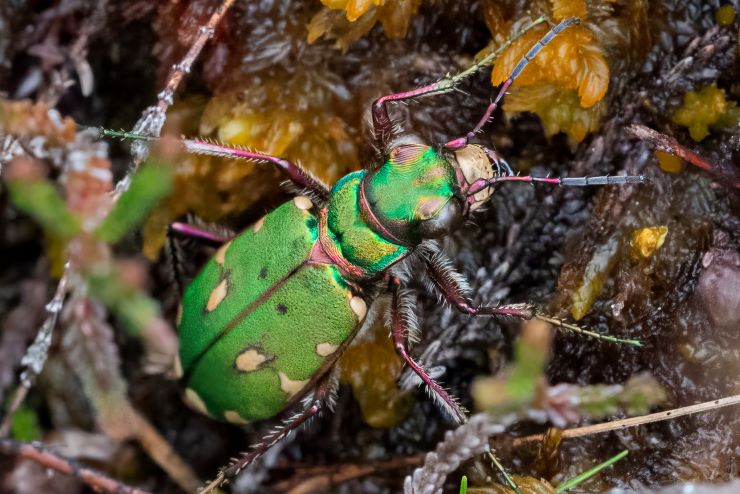
Green Tiger Beetle (photo by Simon Gray)
The Large Heath Butterfly is rare in Great Britain and Europe, but it is quite common in Northern Ireland especially in raised bogs. The caterpillars feed on cotton grass. An Creggan and Ballynahone are good places to look for them.
Another butterfly found on peatlands is the Green Hairstreak. They often congregate in birch trees where they are very difficult to see. The caterpillar feeds mainly on bilberry.
The Marsh Fritillary Butterfly enjoys wet and boggy places. The caterpillars spin a communal web binding together leaves of the foodplant in which they live and feed. This plant is often devils bit scabious. After changing into the 4th instar, the larvae build a dense nest of silk low down in the vegetation where they will spend the winter hibernation. They will then emerge in Spring. Light grazing with cattle instead of sheep have been seen to benefit this insect. South Sperrin’s and Fermanagh are very good areas to see them.
The Emperor Moth, a member of the silk moth family is a large fluffy insect with eyespots on all 4 wings. They have big warty caterpillars which change from purple to green when they mature and feed on heather and bramble and meadowsweet. It overwinters as a pupa which is often predated on by small mammals during the winter months. It is common and widely distributed throughout peatlands in all the counties.
Dragonflies such as the Black Darter and the Four Spotted Chaser inhabit peatlands like Ballynahone bog and An Creggan as does the Large red damselfly, our only red damselfly.
The one reptile in the North of Ireland is the Common or Viviparous Lizard which can be found throughout Northern Ireland especially in the Mourne mountains, the Antrim plateau and the Sperrin Mountains. They are very quick animals but can sometimes be seen on a rock on a spring cold morning when they are sluggish and trying to warm themselves. Population numbers are not yet known.
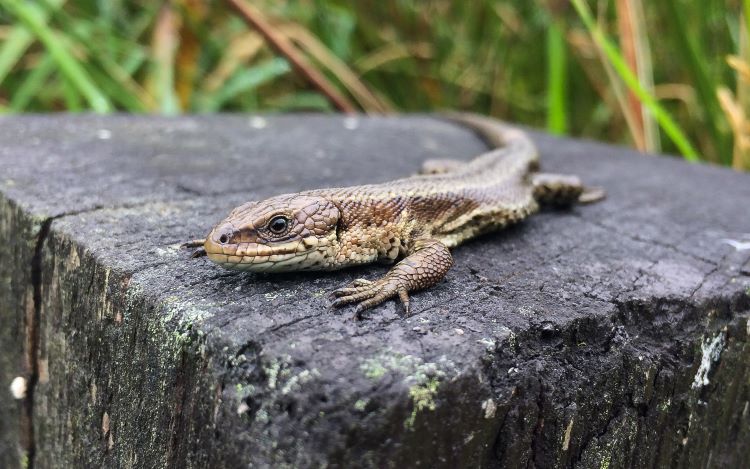
Common Lizard (photo by Simon Gray)
Plants which can only survive on acid soil and those which get their nutrients from insects are found in peatlands The Bog Rosemary is a small evergreen shrub covered in pink flowers in Spring. It is found on Ballynahone Bog and Peatland Park and seem to be more prevalent in bogs which are not looked after.
Sphagnum mosses are very important plants and are the major component in peat which they form, as they slowly decay over hundreds or thousands of years. There are over 35 different species in the UK all liking different conditions and all different colours. For centuries it has been used to treat wounds because of its antiseptic properties and it can restrict bacterial growth due to its acidity. It’s also very absorbent and can absorb up to 20 times its volume in liquid. At one time it could be used as a’ nappy’ for babies because of its sponge like ability! Peatland Park is a good place to see it where it grows in abundance.
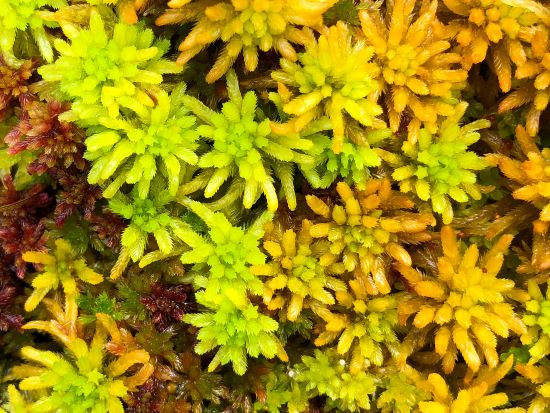
Sphagnum Moss--the building block of peatland (photo by Simon Gray)
The Bog Bean plant requires very wet areas. It has pink and white flowers and can be made into a wine or tonic. Simon asked if anyone had tasted this black tar like molasses as he would like to try it! It is supposed to be a cure for everything but is very strong and bitter!
The Bog Asphodel has golden yellow star like flowers. It requires very acid ground. The Latin for it is ‘bone breaker ‘as it was said that if eaten by sheep and cattle their bones would break. Probably this is more likely due to the uneven ground the animals were grazing on. One thing which is true is that sheep can develop light sensitivity to it especially on their ears.
Years ago, Bog Cotton would have been harvested and used to stuff pillows and to make insoles for shoes. It is a sedge with white fluffy pom poms at the top of their stem. The plant has air canals in their roots which allows air to pass from the parts of the plant sticking out of the water to the roots which can be buried up to 60cm into the wet peat. Hare’s tail cotton grass is closely akin to it and forms tight tussocks with silky white plumes like the bog cotton. These resemble a hare’s tail or paw.
There are three types of Sundews which are insectivorous plants, the round-leaved sundew, intermediate sundew and the long-leaved sundew. They are found growing on wet acid bogs They have globe like sugary parts which attracts flies and other insects and these close over trapping the insect which is eventually turned into a nutrient rich soup The plants benefit by absorbing minerals especially nitrogen and phosphorus. Peatland Park has a lot of these plants.
The Bladderwort is another insectivorous plant, The leaves are highly segmented and modified to form bladders. It is these bladders or small hollow sacs that capture and digest tiny insects such as water fleas. The Common Butterwort is a similar plant. It has very violet flowers and sticky glandular leaves to lure, trap and digest insects in order to obtain more nutrients from what they can get from their environment.
Simon ended this fascinating talk by asking if any person that would like to help the peatlands recovery project by volunteering and helping with surveys or doing physical work for instance to contact him.
Lecture Summary written by Maureen Graham Hon Secretary