


 English
Ernest Hunter, our chairperson welcomed everyone and extended sympathy to the family of Rhoda Jones who recently passed away. Mentioning our coach trip in June he said there were still seats available on the bus. A £10 deposit is required by all who are going. Some deposits have been collected. Ernie thanked everyone who had submitted articles for our 65th anniversary book and encouraged more members to enter. Sharon Loughrin announced that Lissen House on the 19th of March is having a talk by Lolly Spence on C.S. Lewis. Tickets are £10 each which includes a mini tour of the downstairs of the House and light refreshments. Our original speaker who was going to give a talk on curlews was not available, so Mark Smyth a regular speaker at the club stepped in to talk about bats.
Mark opened his talk by asking a few simple ‘yes’ or ‘no’ questions such as are bats blind; are they dirty all of which received negative answers. Bats are members of the Chiropter family which means ‘hand wing’ . They are not rodents nor are they even related to them In fact it is thought by scientists that their nearest living relatives are cetaceans and ungulates. Mark emphasized that all people who work with bats have to have a licence as well as rabies inoculations.
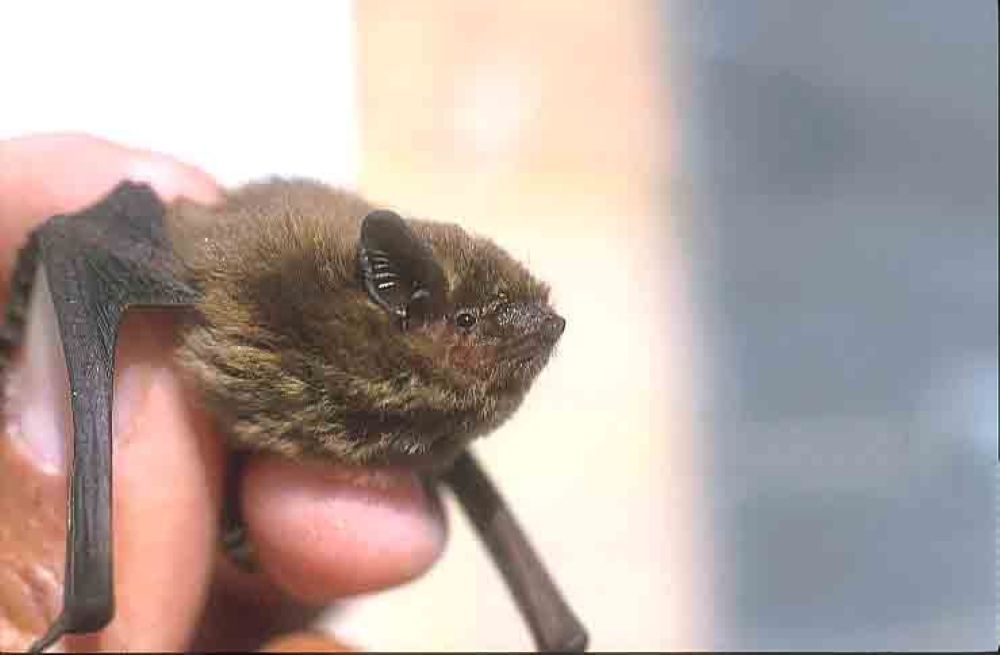
Soprano Pipistrelle--photo by Mark Smyth
One in five mammals are bats. Bats are the only mammals that truly fly and to accomplish this they have very thin wings. Bats ,especially long eared bats, love country lanes with tall hedges. Not all bats hang upside down and those that do have a mechanism in their foot which when they grasp on to something makes their grip very strong. Mark explained that while bat boxes are useful it is important to get a good one which are usually, expensive but been moulded of a wood fibre and cement mix means that the boxes have better insulation than the more common wooden ones. Bats do not like fluctuating temperatures.
Hibernation ends in April although bats may be spotted flying on sunny winter days. Baby bats called pups are born in May and June and by 6 weeks are independent of their mothers. It has been found that male bats sing a very specific song to get the female’s attention and will also mix up their songs and sing very loud to impress her! Just before hibernation sperm is stored in the female bat and fertilization is delayed for weeks or months and does not commence for about 1-3 weeks after waking from hibernation when the egg is then fertilized . Some other animals who have this delayed implantation are seals, otters, weasels and kangaroos. When born the pups are naked and are the size of a jellybean which although may seem small is actually very large for a mother bat to give birth to .Baby bats feet are very well advanced so that they can cling on to their mothers, walls or trees.
One well known fact is that bats use echolocation to find prey and avoid obstacles. They squeak all the time, and this noise will get faster as they near an object. It has now been discovered that in response to bats threat many night flying moths have evolved ear-like organs which can pick up the bats squeaks and allow them to take evasive action. Some bats like the large Leisler’s bat will emerge before sunset but most emerge 15 mins afterwards .
The world has 1100 species of bats with Costa Rica having the most at 300. Northern Ireland has 8 bats These include the soprano, the common and the nathusius pipistrelles The soprano pipistrelle is small and can be seen around new housing developments and because it is tiny it can only consume very small insects. The smell of its droppings can be overbearing especially on hot summer days! The common pipistrelle is a reddish colour and is found mainly in the countryside.
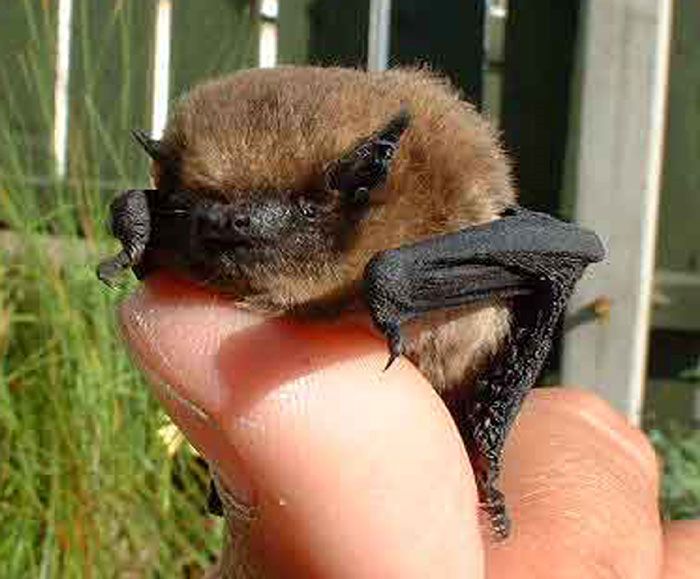
Common Pipistrelle--photo by Mark Smyth
In 2017 the nathusius pipstrelle was discovered in this country. It is larger than the other two and hairy and is always located near water such as around Lough Neagh, Shanes Castle and in Co. Fermanagh, it likes to roost in old stone buildings and will fly up and down rivers hunting for prey.
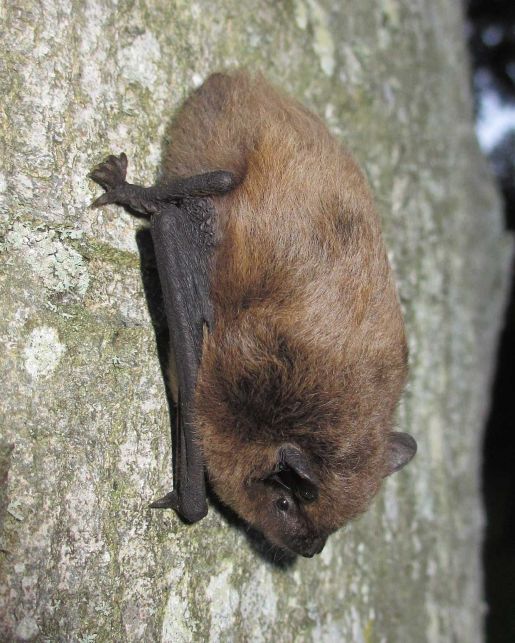
Nathusius pipistrelle-photo by Mark Smyth
The Leisler’s bat is also found in Northern Ireland. It is our largest bat, the size of half a banana! It has a 10–12-inch wingspan and can fly fast after it's preferred prey which are beetles. This bat also ‘stoops’ which means it will go high and suddenly drop down on any unsuspecting beetle. It likes to use old buildings. Another bat found in Northern Ireland is the whiskered bat. Mark says this is the "posh" bat as it likes to live in undisturbed old mansions. When it flies after its prey it will feed within the canopy of trees. The whispering bat is better known as the long-eared bat. This cute bat has hugh ears which means it can locate its prey even if it on the ground by using both echolocation and hearing. It is such a quiet bat that even with bat detectors it is difficult to hear. The Natterers bat is also rather a posh bat as it is often located in 1800s buildings especially in their attic and in stone walls. It has large ears, is quiet and can feed on moths, spiders and beetles on the ground and on foliage. It also has a feeding perch where it consumes its prey. The last bat to be seen in Northern Ireland is the daubenton’s or river bat This bat has two toned fur, is very heavy and has long legs and big feet . It can catch insects and small fish. It loves still rivers and will never roost near people as they prefer roosting in a tree hole or in a crack on a bridge ,
The lesser horseshoe bat is rare due to habitat loss and restoration of old buildings. It has also been discovered that the use of insecticides on cows is killing off the beetles which this bat relies on to eat. Found in west and southwest Ireland, it echolocates through a series of nose leaves and is a beetle specialist, flying very low to catch them. They like hedgerows. The greater horseshoe bat is similar to the above although it is bigger about the size of a plum. It was discovered in Ireland in 2013 .
Mark then talked about foreign bats such as the fruit eating bat which is responsible for reseeding forests by eating the pulp of fruits and excreting the seeds, then the frog eating bat which only eat male frogs. This is because the male frogs make sounds to attract females which the bat can hear. It is also quite specialised in that some will catch only specific species of frog .The tube lipped bat feeds at night on flower pollen .The blossom bat feed on pollen only. The bulldog bat eats fish and has an expanding cheek pouch where its food can be stored.
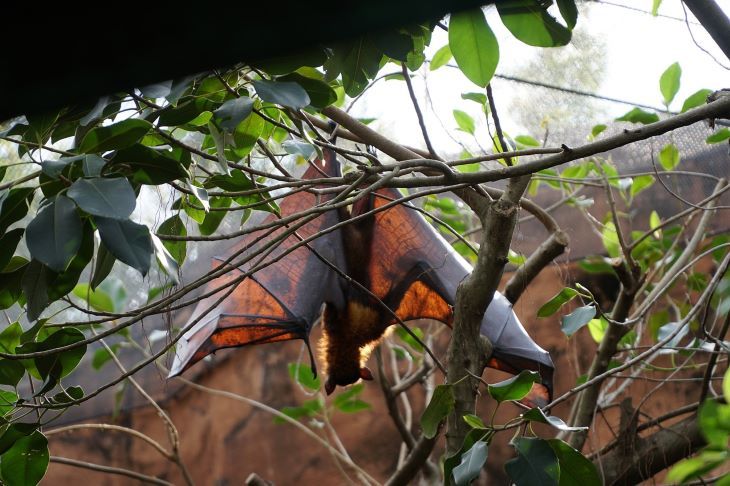
Rodrigues Fruit bat
Everyone is familiar with the vampire bat which contrary to beliefs prefers to suck the blood from farm animals than people. It has heat sensors on its nose to locate its prey. Its saliva has anaesthetic and anticoagulant qualities. It will bite an animal and crawl away to wait before it comes back to its prey to lap up the blood It is one of the few bats which is very sociable and will share food with others in their group.
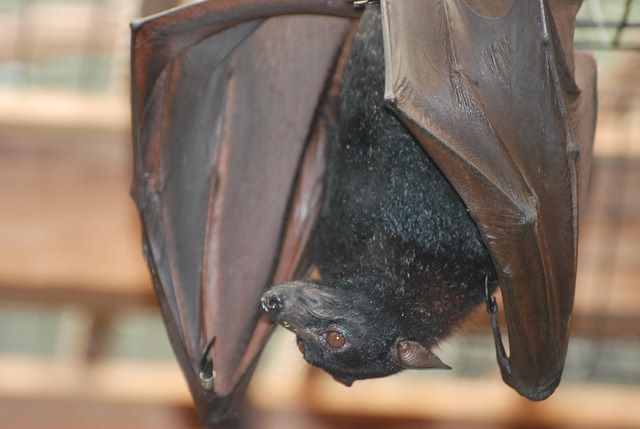
Vampire Bat
Mark finished his lecture by telling us some amazing bat .facts The painted bat lives in unfurled banana leaves and it has suckers which helps it to hang on. The fruit eating tube nosed bat has spots over its wings to help in camouflaging it. The spectacle of 22 million Mexican free tailed bats emerging from a cave in Texas is amazing. It is also home to snakes which feed on the babies and any sick individuals Despite their large numbers the mother bats always know where their baby is when she comes back from a hunt. These bats also have to contend with birds of prey waiting to catch them when they emerge from the cave. Mark told us that the smallest bat in the world is the bumble bee bat weighing less than 2 gms It is very cute! Not so cute are the trident nose bat, the enormous hammer head bat, the spear-nosed bat and the wrinkle faced bat from South Africa.
After many interesting questions from our members Alan Aitken gave the vote of thanks and this was followed by refreshments.
"Batty about Bats" lecture report by Maureen Graham Hon Secretary