


 English
Butterflies Cathyrn Cochrane 8th April 2025
Our chairperson, Ernie Hunter welcomed everyone to our last lecture of the season which was followed by the AGM . Before the speaker was introduced, Ernie said there were still seats available on the bus trip in June. Closing date for entries to be submitted for our book is now to be 16th May, and again he emphasised that articles can be short or up to 1000 words and can cover a wide range of nature subjects from favourite talks to interesting wildlife encounters. Volunteers have been requested by Ballinderry Fisheries to monitor stretches of the Ballinderry River and our member Sharon Loughrin also required volunteers to help rake the mowed wildflower meadow at Lissan .
Alan Aitken then introduced Cathyrn Cochrane who talked on Butterflies Cathyrn has a passion for insects especially dragonflies, butterflies and moths. She is a member of the Northern Ireland branch of Butterfly Conservation which was formed in 1968 and whose President is David Attenborough. Its aims are to promote scientific interest, practical conservation action and encourage people to enjoy butterflies.
There are 180,000 species of butterflies worldwide. Twenty-seven live in Northern Ireland . Cathryn proceeded to tell us about some of these. They are divided into different groups.
The Whites are well known and comprise the popular Orange tip butterfly. This beautiful butterfly flies in April / May and has one generation The male has orange tips to their wings but in both species the underside of the wings are mottled green. The caterpillars are green and feed mainly on the cuckoo flower but also will eat hedge mustard, sweet rocket and honesty. The pupa although challenging to find is boat shaped and is attached to its food plant .
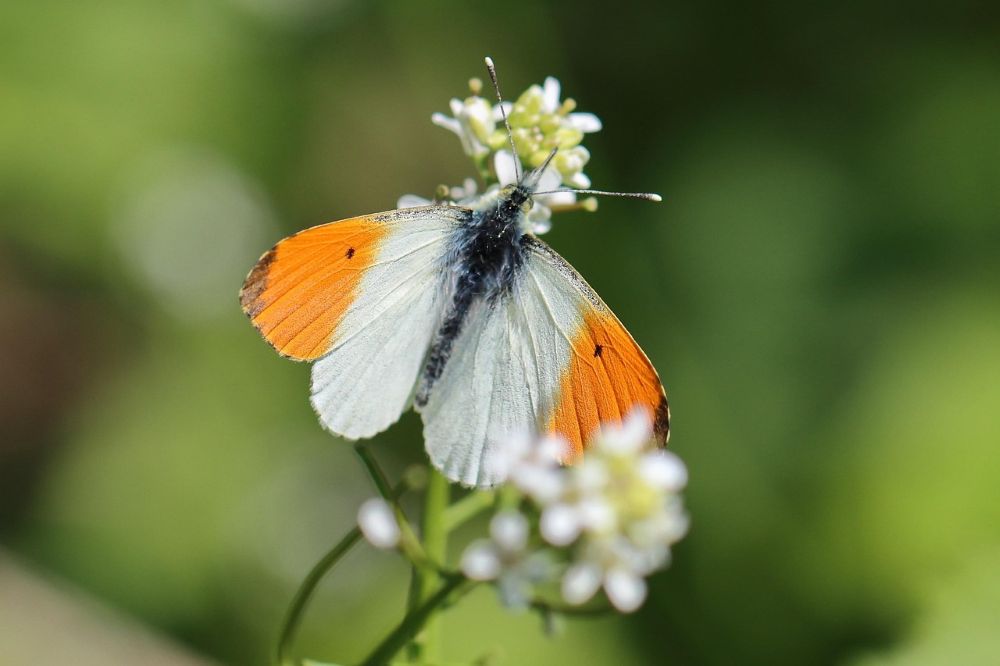
Orange Tip Butterfly
Small whites have two generations and are found in gardens and allotments. Large Whites also known as Cabbage Whites have two generations They have black tips to the wings and a pale underside and are bigger than the Small White. The Green Veined White has two generations .They have fine grey lines with a very yellow underside. Their habitat is around rivers and banks. The Cryptic Wood White is found in Ireland and is common in Northern Ireland. It can be seen in late April and has a very weak fluttery flight with a dusty white underside and rounded wing edges. They enjoy open habitats and the caterpillars feed on meadow vetchlings.
The Browns are composed of the Ringlet which looks dark in flight When seen close up they have a velvety dark appearance with a white fringe to their wings. The small circles on the underwings give this butterfly its name. It’s found on long lush grass. The Meadow Brown is bigger, brown above with orange patches and two spots on its forewings. Both sexes differ. They frequent areas of long grass . The Small Heath is small and looks very bright orange in flight .It prefers short grass.
The Speckled Wood has two generations and is speckled with cream spots. It has a lazy flight .
The Common Blue is seen on the wing from July to September especially in sunny dry weather. The males usually have wings that are blue above with a brownish border .Females are usually brown above with a scattering of blue colouration. Caterpillars feed on bird’s foot trefoil .
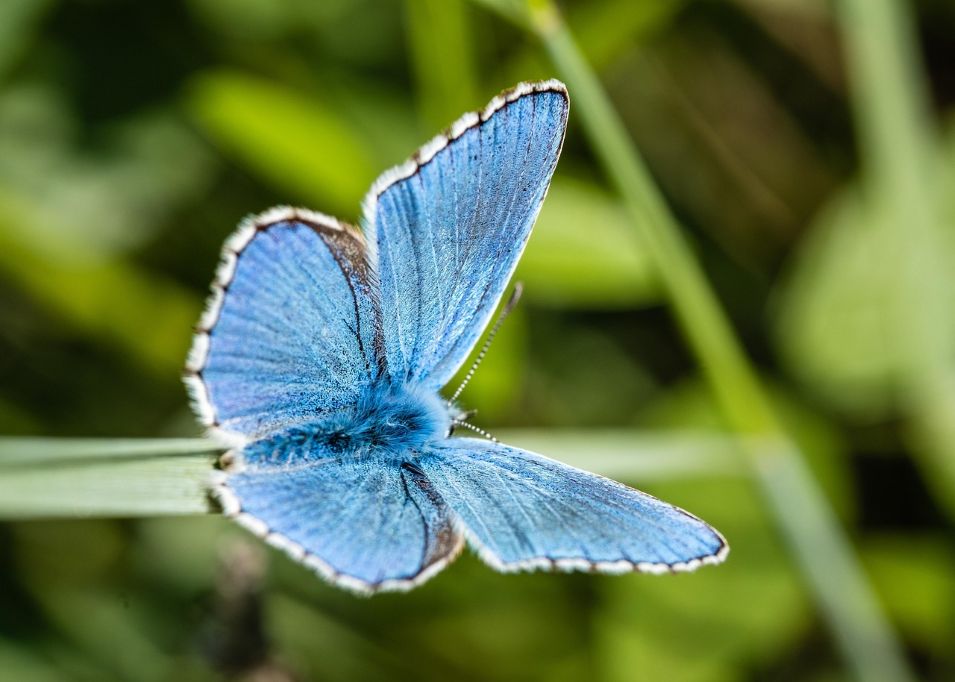
Common Blue Butterfly
The Small Tortoiseshell belongs to the Nymphalid family. It is mainly a reddish orange colour and is well camouflaged when its wings are closed . The Peacock has large eye spots and like the Small Tortoiseshell it may overwinter in garages and outhouses .
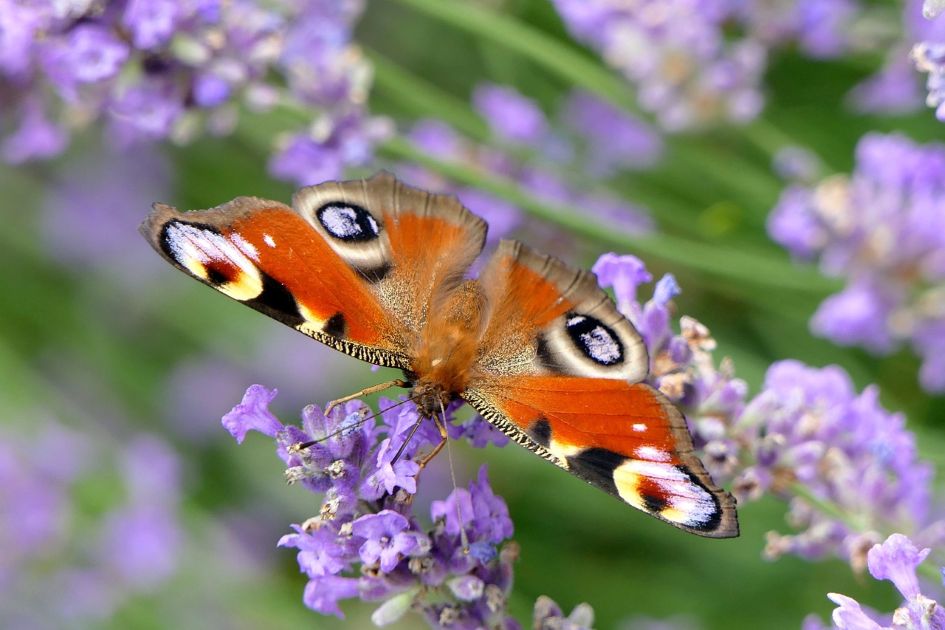
Peacock Butterfly (overwinters in garages and outhouses)
The Painted Lady is migratory and travels to and from Africa .In some years thousands can arrive on our shores. They are a very pale orange with dark patches and white spots.
Red Admirals are mostly migratory and can be spotted flying late in summer They are a large butterfly and at a glance are predominantly dark with a red band on the wings and scattered with white along the edges. They adore buddleia plants. The Comma has a ragged outline and is found at the edges of woods .The adults overwinter.
In 2015 there was a report on butterflies. It was found that three -quarters of UK species have declined .Cathyrn says this can be due to factors such as habitat loss, removal of gorse, hedgerows and nettles, overuse of pesticides, loss of flowers, loss of meadows (over 98% have disappeared and climate changes.
Butterfly Conservation does an important job providing advice on butterfly projects and on protecting sites ,reintroducing butterflies to areas and creating new wild spaces for them to live, advising on plants to attract butterflies and educating the public on butterfly importance such as in food chains and to our mental health.
Cathryn mentioned RHS Greening Grey Britain Project. Gardens can represent 50% of space and are therefore an important habitat for butterflies. Plants should be picked on their attraction to insects. The old-fashioned cottage garden styles are good
Butterflies rely on nectar and pollen. This is especially true of the butterflies emerging from hibernation in March April and May . Some beneficial plants to have in the garden at this time of year are Grape hyacinths, Hyacinths, Lungwort, Hellebores native Primroses and Bugles .From June to August good plants are Cornflowers, Thistles ,Catmint and Verbena. From August to October Sea holly ,Michaelmas Daisy, Sedum and Buddleia will attract butterflies especially Red Admirals ,Peacocks and Tortoiseshells. Even small window boxes are useful and can be turned into a mini garden and planted with not just flowers but herbs like chives and rosemary. Its important to take a relaxed approach to gardening , not to be too tidy and to leave for example, shrubs unpruned and clippings unburnt .
Questions were then asked and Mike McGrath gave the vote of thanks .As it was our last meeting Ernie thanked all members for supporting the club and reminded everyone of our first field trip – a dawn chorus outing to Lough Fea on the 18th May at 8am A light supper then followed .
Lecture summary written by Maureen Graham Hon Secretary