


 English
Ernie Hunter, our chairperson welcomed everyone, including new members to the first meeting of the season. He paid tribute to Kevin Johnston, a member and past chairperson of the club who sadly passed away in July. Our upcoming book launch at Lissan House on 26th September was mentioned before Ernie introduced the speakers for the evening Dr Roy and Dr Kathyrn Nelson both members of Cookstown Wildlife. Roy has a background in agriculture, social science and woodland management. He was a Queen’s University senior lecturer for many years at Loughry College. He currently teaches environmental classes on woods and trees at the Queen’s Open Learning Centre in Belfast. His wife Kathryn has a background in visual art, ecology and education. She gained her PhD from Queen’s University in 2024. Her thesis was concerned with ecological knowledge dissemination through culture and particularly visual art. They have converted several acres of their farm into woodland.
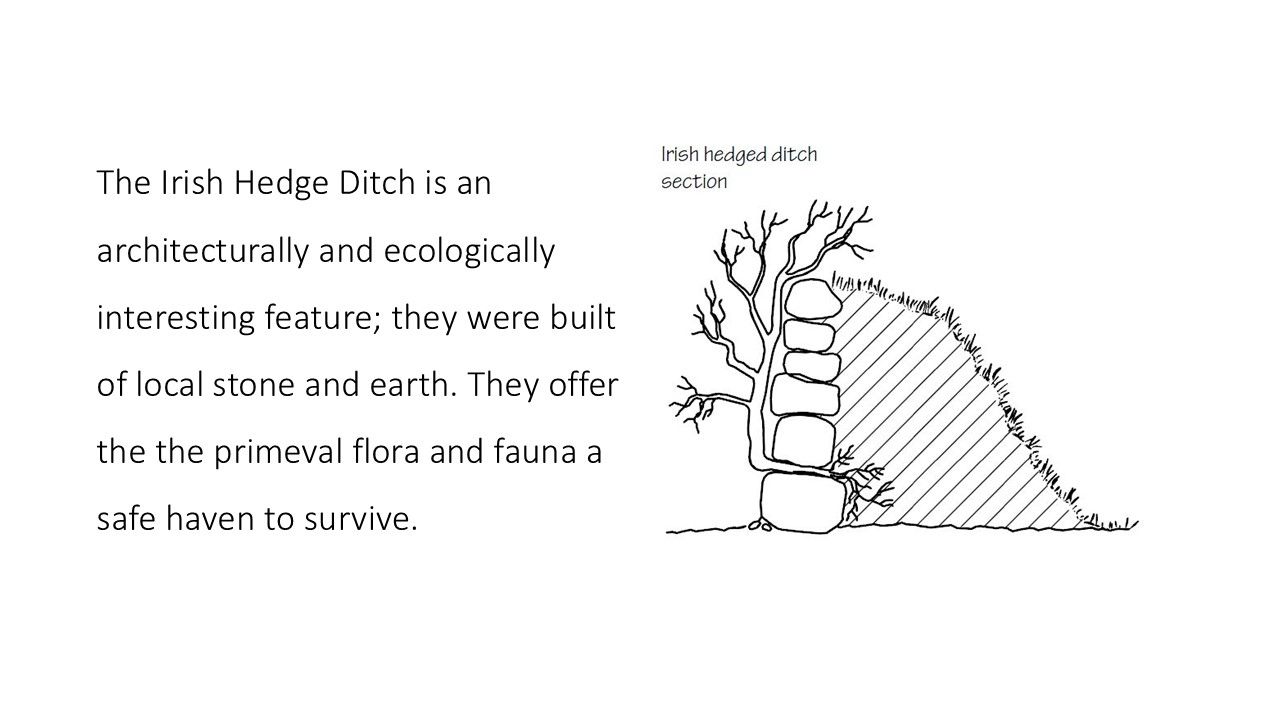
Kathyrn began her address by explaining the importance of habitat corridors in other words hedges which not only act as nature corridors but also as a refuge for woodland species. Some of the oldest hedgerows can be traced back to medieval times and even earlier. She explained the different types of hedges including the Irish ditch hedge. This is the term for the combination of a hedgerow and an accompanying trench It is formed by digging a ditch and piling the soil to create a bank which is then planted with shrubs or trees to form a dense hedgerow . Ancient hedges are home to so many different species such as wood anemones, wood sorrel, bluebell, violet and stitchwort as well as animals like hedgehogs, amphibians and many birds .Unfortunately hedges are being lost to modern agricultural practices.
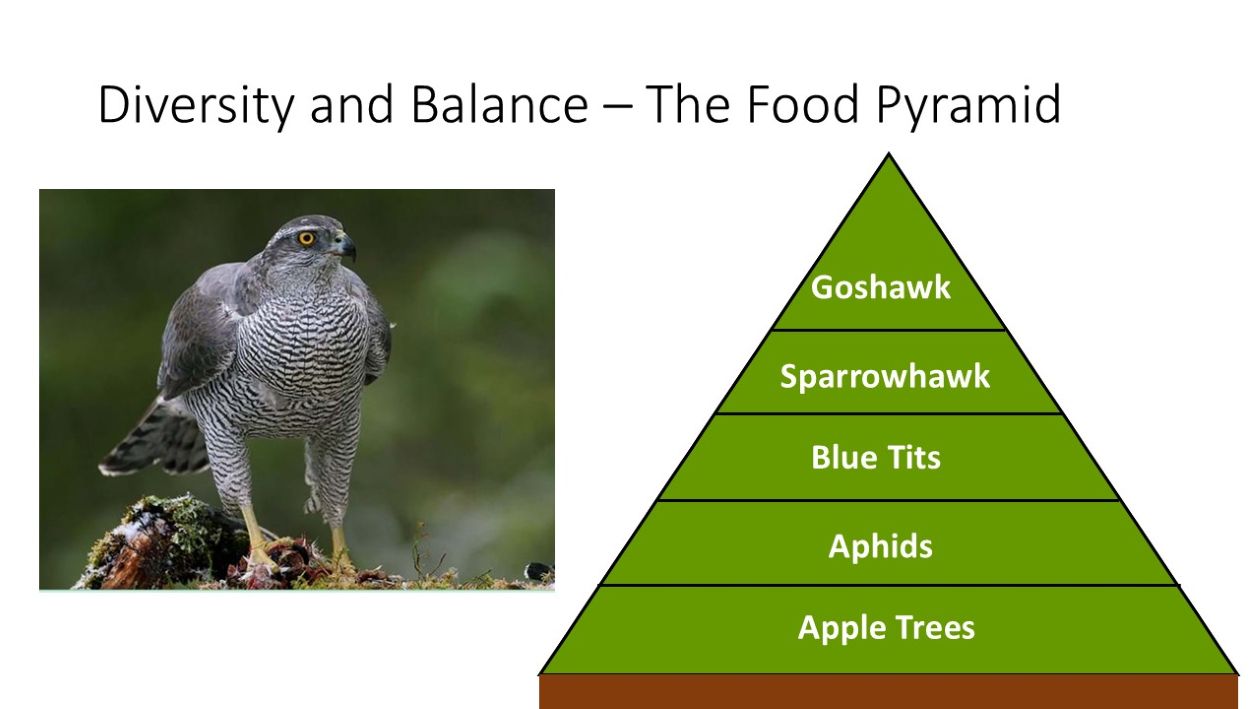
The second part of the talk was delivered by Roy. He spoke on the principles of rewilding. The aim, he said is to restore and protect the natural environment with limited human intervention in other words ‘Let nature do its part’. Roy explained how diversity and balance is important . He used an ecological pyramid diagram to illustrate this. At the bottom is soil which is vital in supporting plant and animal life. The next layer contains plants, for instance our native crab apple tree. Above this are aphids which are abundant on apple trees and above this are blue tits or the ‘pest removal service’. They consume a large amount of aphids. Above the blue tits are sparrowhawks. They predate on small birds regulating their numbers so that mortality from starvation and disease is decreased. The apex predator is the goshawk. This large bird of prey feeds on mammals such as rabbits and medium to large size birds like the sparrowhawk, magpie, crows and jays. Weighing five times as much as the sparrowhawk it was once common but is now scarce in Ireland. To introduce more of these birds, requires space and agreement from people living in the area. Unfortunately, not all outcomes are known but without trying there is an imbalance in the countryside. A predator even further up the pyramid which preys on goshawks are eagle owls. They are sparsely distributed in Europe and Asia and inhabit a wide range of habitats. They are often found in the largest numbers in areas where cliffs and ravines are surrounded by trees and bushes. Five were released to rebalance ecosystems in the Danube delta in 2024. They were once found in Ireland but disappeared around 200 years ago, although there have been sightings in Belfast and other parts of County Antrim, all probably escapees. The problem of reintroducing them is they require space, are very territorial and have the potential of becoming dangerous especially if there is not sufficient prey.
Roy also mentioned the idea of introducing Megafauna to our countryside. Megafauna species are large animals like deer, wild ponies, lynx and wolves. They have considerable effects on the local environment including the suppression of woody vegetation as well as regulating the over abundance of smaller animals. Again, this might improve biodiversity but there is no guarantee. They need space and agreement of the local community. There is also the problem of whether to intervene if they are starving or ill.
Integrated development is where habitat is restored in an evolutionary way. Roy mentioned beavers, calling them the ecosystem engineers. They make changes to their habitats such as coppicing trees ,damming smaller water courses and digging canal systems. By doing this they help to manage flood risk and even combat drought as well as bringing benefits to other species such as otters ,dragonflies and breeding fish. As previously mentioned, a suitable habitat is needed, support from the local community is essential and regulations regarding health and safety have to be discussed. Introducing wild boar for instance could prove a threat to crops, transmission of diseases and public safety problems as wild boar can be very aggressive.
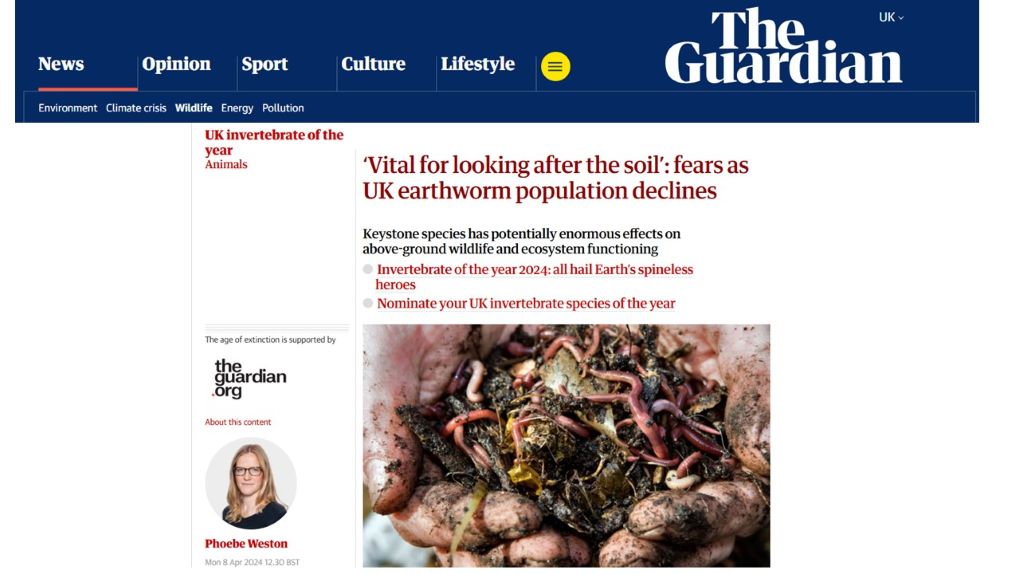
An unsung engineer of nature is the earthworm. There are 31 different species in Ireland. Their cast or waste material is very rich in nitrogen, phosphorus and potassium all of which improves the soil. The poor earthworm is in trouble. A third of them have been lost in the last 25 years. They are under threat from intensive farming, heavy machinery, microplastics, pesticides especially glycophosate, inorganic fertilizers, heavy rains and lets not forget New Zealand flatworms.
Roy explained that our gardens could be rewilded. In a conventional garden grass is kept very short and mowed often during the summer months. Even worse is the use of plastic turf and plastic flowers which all create a tidy but sterile garden. Who wants to see plastic delphiniums in February? In a nature friendly garden grass should be left to grow until August, weeds should be seen as beautiful, native flowers should be sown even if only in a window box .Rewilding means no chemicals and the garden should be made attractive to wildlife by for instance adding nest boxes, making bee hotels and installing a pond. Decay should be embraced by leaving fallen trees and having log piles and compost heaps.
Finally, Roy talked about townland names,how they describe a snapshot of landscape and people and how their names can be linked to what the habitat once was. There are 55 townlands in Desertcreat where our meetings take place with 31% referring to woodland.
Roy and Kathyrn would both like volunteers to help in a survey of hedgerows in a small sample of our local townlands in April or May next year. After questions and the vote of thanks by Charlene a light supper followed.
Lecture Summary written by Maureen Graham Hon Secretary