


 English
Ernie Hunter our chairperson welcomed a large crowd to our February meeting. He mentioned our CWT members mobile phone photographic competition, all entries to be in by Friday 30th October. He then introduced our speaker Ross McIlrath who since 2021 has been Priority Species Officer for Ulster Wildlife. He is involved in conservation efforts with species such as pine marten, red squirrel and barn owl which was his topic for the evening.
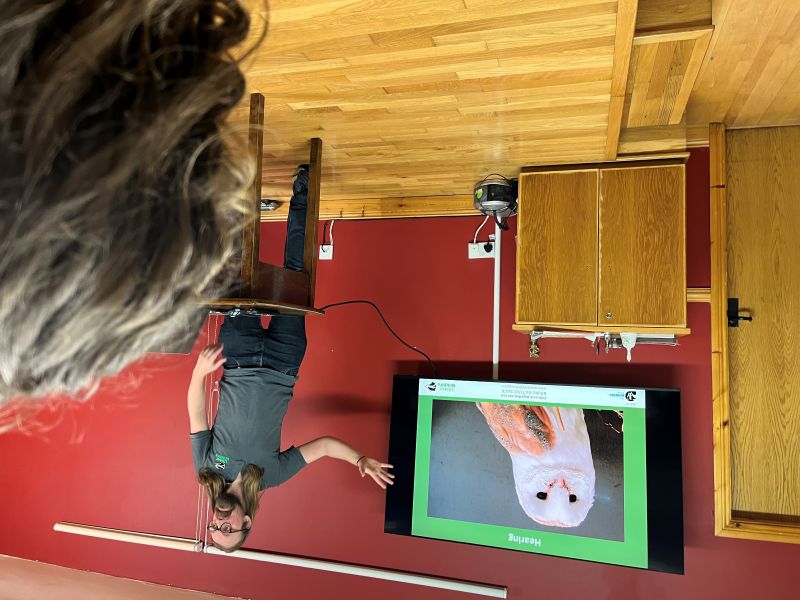
Ross McIlwrath from Ulster Wildlife spoke on Barn Owls
Ross introduced us to the barn owl which can sometimes be known as the ‘graveyard screecher’. This is because of its ghost like pale appearance and its chilling high-pitched screech, a sound which is associated with the legend of the Irish banshee.
The barn owl in Ireland is whiter underneath than its counterparts in the rest of the UK. It is the size of a woodpigeon, but it looks bigger due to its wingspan which can reach up to a metre in length. It has white underparts with beige back and wings mottled with grey. It has large dark eyes which are fixed and they use their head much more than normal. Their hearing is good with ears situated in the front of their heart shaped face. These are at different heights which means they can pinpoint sound more effectively. Their whole face is one listening device.They have good night vision which helps them locate prey and this with their exceptional hearing makes them very efficient predators.
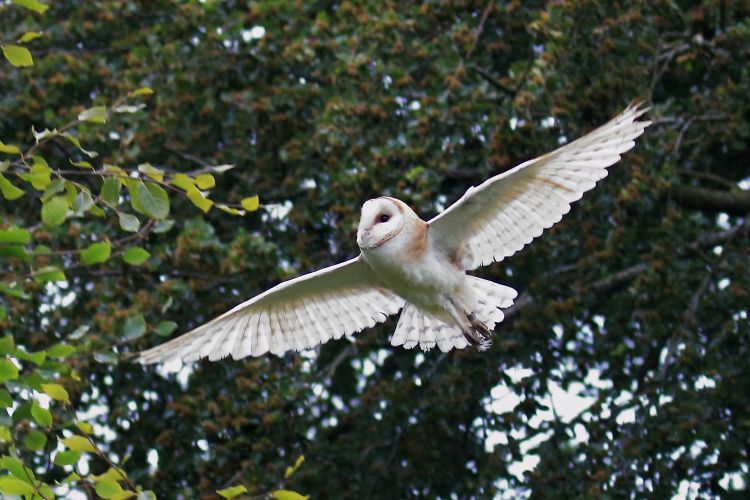
Barn Owl ---photo by Ronald Surgenor
The male is whiter in general than the female. Barn owls can fly well and have long white ‘socks’ or feathers all over their legs to protect them from injury when they pounce for instance into prickly bushes after prey. They have a silent flight which enables them to hear very tiny sounds produced by small mammals and thus can approach them undetected. How this is achieved is by having feathers which are specially adapted with fringed edges that break up the air turbulence as they fly thereby reducing the sound of air rushing over their wings. The softness of the feathers also helps to give the bird silent flight. ‘Talon flange’ refers to having a special comb-like edge on the underside of their middle toe talon. This feature is used for preening especially the face. It is important for these predators to keep their feathers in good shape.
Ross then told us that Ireland has two other species of owl: the long-eared owl and the short-eared owl. The latter is a migrant only occasionally spending time here. They can be seen in Spring and Autumn and are active during the day They breed in Scotland and Scandinavia and are only sporadic breeders in Ireland . The long-eared owl is relatively common in Ireland compared to in the rest of the UK. It is a woodland species, and its so-called ears are actually prominent feather tufts or plumbicons which it can raise for camouflage and communication. Sometimes they may be mistaken for the barn owl especially in flight although they are darker and on closer inspection barn owls have an orange eye and not a dark eye like the long-eared owl.
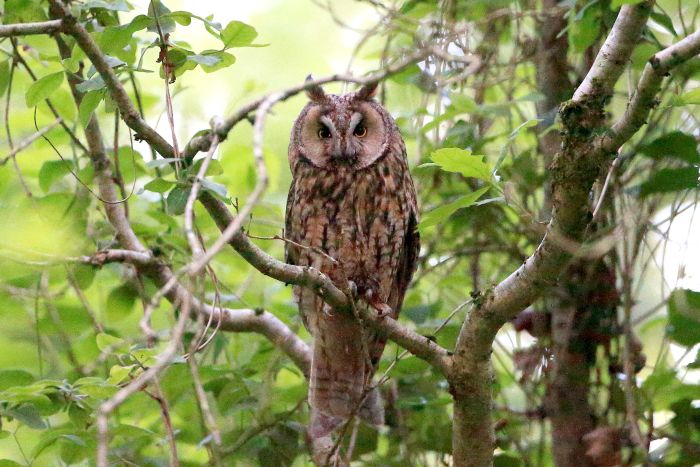
Long-eared owl --photo by Ronald Surgenor
65 percent of the diet of a barn owl in Ireland is wood mice followed by rats and pygmy shrews The latter is an important food source for young owls learning how to cope with devouring whole prey. The average adult will consume 3 to 4 mice per evening They have an interesting digestive system with 2 stomachs. The first chamber breaks down the prey and the second squeezes the food until only the bones, fur and teeth are left. This is regurgitated as a pellet which is the size of an average thumb nail and very dark. These pellets are themselves broken down by moths.
Originally barn owls nested in tree cavities, but because of scarcity they now also use buildings. The buildings they prefer are built of stone with many entrances and with flat ledges inside to lay their eggs on. They require a dark, quiet and safe space. The female is smaller than the male. She creates a shallow scrape on dirt on the ledge. Eggs are laid one at a time and unlike other birds are incubated as they are laid. Up to fourteen white round eggs can be laid but usually the number is six. Barn owls always have different ages and sizes of chicks with the parents concentrating on feeding the older larger chick. During difficult times the older chick will eat its siblings. The female will stay on the eggs all the time with the male bringing her food. When all the eggs are hatched, she will incubate the chicks for a time but once the chicks are larger, she will start hunting again and will leave them at the nest site. She will also roost separately from them. The chicks make a very different sound from their parents. Unlike the screech of their parents, they have a snoring sound which they make to the parents and to warn predators off. This sound can be heard in May. Both parents feed the chicks for around 14 to 16 weeks. Once the chicks have their feathers they will remain in the nesting area.
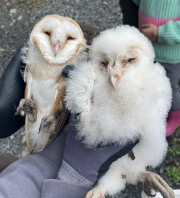
Barn owl sibling chicks hatch at different times ---photo by Katy Bell
Compare this to the long-eared owl which uses old crows or sparrowhawks nests high in a tree. At 6 weeks long-eared owlets ’ ‘branch ‘ onto the tree branches even though they cannot fly. They can move which enables them to escape predators if they have to. They have a distinctive squeaky gate noise to attract their parents and are very curious.
Ross says the barn owl likes open habitat or rough grass bordering on woodland which has plenty of little hidey holes for their rodent prey. Cereal crop is useful in autumn as when it is cut it attracts rodents which in turn attracts the barn owl. Wild bird seed mix crops are also useful.
Unfortunately, barn owls are scarce in Northern Ireland There are more in Co. Antrim Co Down Co. Fermanagh and only a few in Mid Ulster. There are less than 30 pairs with 16 nesting sites accounted for. Why so few owls over here could be due to the colder weather as in prolonged rainy windy spells the bird cannot hunt, they store surplus kills and eat them when this happens. A lack of suitable nesting sites is a problem especially with the loss of deciduous trees with cavities. The use of poison to kill rodents is of a big concern as even though it may not kill the bird immediately it will lead eventually to internal bleeding and a slow painful death. Even open water troughs for livestock can be a hazard for the owl as can electricity wires. But perhaps an even bigger threat is death on the road. This owl flies low about 3 metres off the ground making it vulnerable to traffic on roads and motorways. Ten birds have been killed by lorries in the last 3 years which is quite a sizable amount of the Northern Irish population.
Ross and his co- workers do a lot to help the owls. They give advice to farmers and landowners, and put up large heavy nest boxes in the hope of attracting the birds. They also ring birds and have found that they can fly quite long distances. For example, one owl was found to have travelled a distance of 220 miles from Co Kerry to Co Derry . Talks and events also raise awareness of owls which results in more people reporting sightings to him. Ross ended his talk on how we could help . We could leave rough margins, retain hedges and encourage landowners and councils to plant trees along roads to force the owls to fly higher. Using safer non-toxic methods for rodent control is very important. If a barn owl or nest site is spotted, Ross would like to be informed..
After a question-and-answer session Alison Kirk gave the Vote of Thanks and thanked Ross for a most interesting and entertaining talk. The meeting ended at 9.30pm. A light supper then followed.
Report on lecture by Maureen Graham Hon Secretary