


 English
One of our prettiest resident butterflies is the Orange Tip. It belongs to the Pieridae family which is a large group of butterflies usually white, yellow or orange in colouration. It is widespread throughout the world and is found in Northern Ireland except in upland areas. It is present on Rathlin Island although in small numbers.
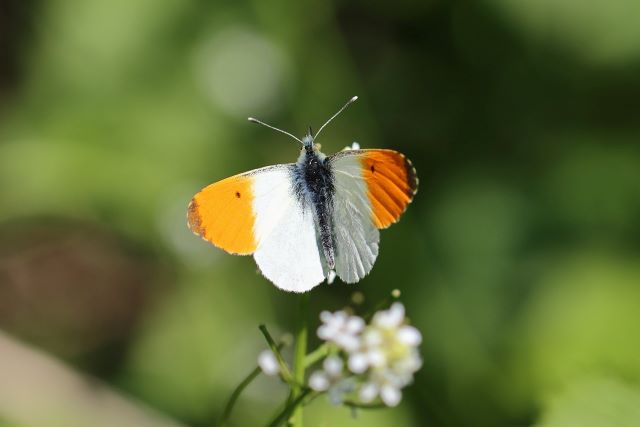
Orange Tip butterfly
It is medium size with a wingspan of 45 to 50 mm. Only the males have the orange pigmentation on the tips of their fore wings. One of the purposes of this is to serve as a warning to predators that they are distasteful to eat --a result of mustard oils that has accumulated in their bodies as a caterpillar! The females are white with black wingtips and can easily be mistaken for two other white butterflies, the Small White and the Green-veined. The way to tell the difference is that both the male and female orange tip have undersides which are mottled green and white (sometimes called parsley markings)
They are well camouflaged and are difficult to spot when resting on flowers such as cow parsley or garlic mustard. They blend in so well that predators will often miss them. Camouflage is also called cryptic colouration which is a tactic that organisms will use to blend in with their environment.
. Both sexes can be spotted flying in bright sunshine from late April onwards although this is dependent on weather. They prefer damp habitats such as meadows but may be found in gardens and along hedgerows and banks. Females are mainly located in open meadows whilst the males can be seen close to the edges of woods and forests.
Males spend their time looking for females. Interestingly males display a variation in body size which is connected to the plants they eat as a caterpillar. For example, males reared on the Cuckoo flower, also called Lady’s Smock are smaller than those reared on Garlic Mustard. When males find a female, they will pursue her. If the female is responsive, she will raise her abdomen, but she will also do this behaviour even when mated. The male however can sense that she has been mated and will leave her alone. Scientists think that this is because of a chemical released by the female which deters the male.
These butterflies are a very good example of sexual dimorphism which means that there is a difference in appearance between the males and the females of the same species. This could for instance be in colour, shape or size. Males of this butterfly have the orange tips and it has been discovered that the female are attracted to males with the brightest orange patches. Gradually the males with dull orange tips will be overlooked by their brighter counterparts and it will be these brighter butterflies who will have the honour of passing on their genes to the next generation. Other examples of this in the animal world are the colourful plumage of male peacocks and the prominent mane of the male lion.
Once mated the female will look for plants growing in a sunny or partial shady area to lay her eggs. Butterflies have taste receptors in their feet which helps the female find a plant suitable for her offspring. Only one egg is laid in an upright position on each plant. They are especially fond of the cuckoo flower and garlic mustard although in my garden they can be found on honesty. Apparently, they do not survive so well on these plants! Other plants sometimes used are turnip, charlock and winter cress. The female is very selective. She prefers large flower heads to smaller ones. She will also avoid flower heads with an egg already laid on it This is because her caterpillars are cannibalistic. The eggs are white at the start changing to yellow and later turning to orange and then finally to a dark violet colour.
When hatched the caterpillar or larva eats its eggshell before consuming the seed pods of the plant. The caterpillar when fully grown is green merging into bluish green on the sides and thickly dotted with shining black specks. There is a pale line down each side. They are predated on by spiders, birds especially blue-tits and indirectly predated by deer like the little muntjac which favours the same plants as the butterfly. It has been estimated that these deer are responsible for eating 9% of orange tip caterpillars!
If you have read The Very Hungry Caterpillar, you will know that caterpillars are always hungry and will rapidly increase in size. Their skin however does not grow so when this becomes too tight, they spin a pad of silk and grow a new larger skin and then shed the old one. This process is called molting. After molting five times they crawl off to find a place to pupate. This could be a stem from their host plant or sturdier twigs on nearby bushes. Pupation occurs about mid-June. They shed their skin before they pupate and then attach themselves by spinning a fine silk to a plant. Inside this structure all the caterpillars’ structures break down and adult structures such as wings and legs are formed. The pupa or chrysalis of this butterfly is a green curious angular shape. They will overwinter in this state and emerge as butterflies the following spring where they feed on the nectar of spring flowers. As they pupate for 10 months this is the longest pupation time of any British butterfly.
This butterfly is not on the Irish Red List and is not afforded legal protection. Potential risk is from climate change and destruction of the habitat of their favoured plants namely the cuckoo flower and garlic mustard.
We can help them in our gardens by providing them with nectar rich plants which are so important when they first emerge from their pupae. Sow seeds of wildflowers such as cuckoo flower, red campion, cowslips and honesty and plant bulbs like daffodils, crocus and bluebells. Provide lots of flowers throughout the summer like lavender, marigolds, zinnias and salvia for the butterflies to feed from. Leave areas of the garden ‘messy’ so that dandelions, vetches, knapweed and clovers can thrive. In Autumn and Winter don’t tidy flowerbeds too much as the orange tip pupae might be attached to the dead stems of plants.
This resident butterfly is the harbinger of spring so let’s hope it will never appear on that dreaded Red List!
Things to make:-
A butterfly feeding station.
Butterflies are always on the lookout for food so why not make it easy for them by making a butterfly feeder. It also means that you can easily observe them even if you have a small garden with little greenery.
You will need.
An old plate
A key ring
Wool or string
Overripe fruit like pears, bananas, oranges and berries.
1.Cut 6 lengths of wool or string, each 2.75 metres long. Hold them altogether and fold in half.
2. Push the folded end through the key ring to make a loop and pull the loose ends through it.
3. Gather the loose ends together and tie in a knot at its end You have now made a hanger!
4 Place the plate in the hanger and hang in a sunny spot out of the wind.
5.Add the overripe fruit and watch and wait. It helps if you have an identification book and a notebook so that you can record the butterflies you see.
NOTE; If you find that the food station is attracting a lot of wasps which can be quite aggressive especially in late summer move the station to another place or cease for a while until the wasps go elsewhere
Books; Oliver and Oliver The Orange Tips Butterflies to spot
Complete Guide to British Butterflies
Children’s page written by Maureen Graham